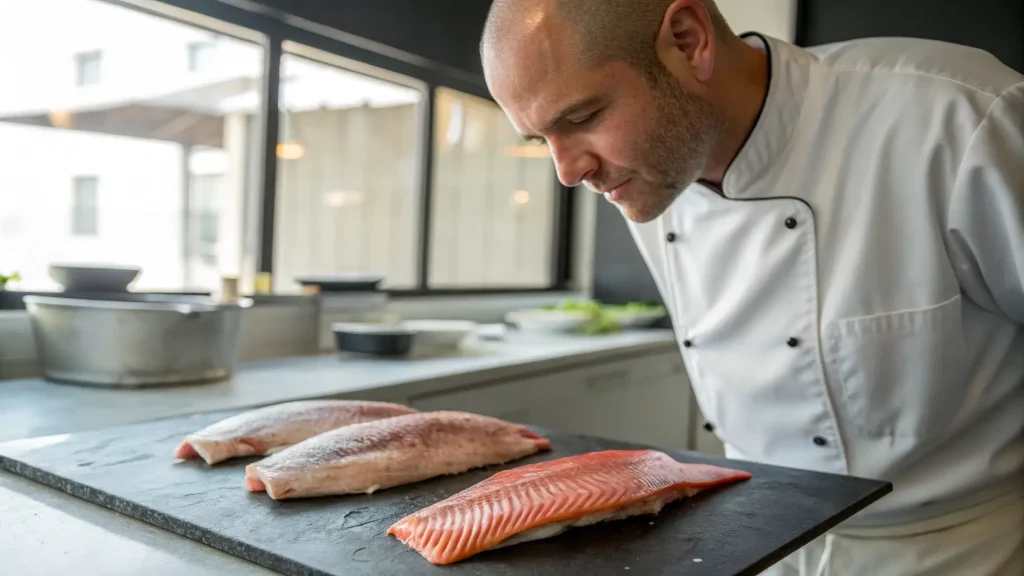
Sourcing frozen seafood internationally involves a great deal of trust. When your brand’s reputation and profitability depend on the quality of a shipment, you need confidence that what you receive meets your exact specifications, every single time. True confidence comes from understanding how to evaluate quality at every critical stage.
This guide is designed to be a practical resource for our partners—importers, distributors, and private label brands. It provides a clear, systematic checklist to help you assess frozen fish products, ensuring the quality you expect is the quality you get.
The Foundation Raw Material Inspection
The final quality of a frozen fish product is determined long before it ever enters a freezer. The freezing process is designed to preserve existing freshness, not to improve a product that is already declining. Therefore, a thorough inspection of fresh raw materials is the most fundamental control point in the entire production chain.
1. Temperature Management
Temperature is the single most critical parameter in handling fresh fish. To maintain peak freshness and safety, the fish’s internal temperature must be held in a strict range of 0°C to 4.4°C from the moment of catch until it arrives for processing.
An unbroken cold chain is the primary defense against bacterial growth and histamine formation. For scombroid species like tuna and mackerel, exposure to temperatures above 4.4°C can trigger the development of histamine, a leading cause for import rejections in key markets like the United States and the European Union.
2. Organoleptic Checklist for Fresh Fish
A sensory assessment is a fast and reliable method for evaluating the freshness of fish before it undergoes processing. Here are the key indicators to look for.
a. Eyes
The eyes of a very fresh fish are convex and protruding, with a cornea that is both clear and glossy. As quality begins to fade, the eyes will flatten and eventually become sunken, while the cornea takes on a cloudy, grayish appearance.
b. Gills
Healthy gills should have a vibrant, bright red color and be clean, with only a minimal amount of clear mucus. Gills that appear pale pink, brown, or gray, or are coated in a thick, opaque mucus, are a definitive sign of decomposition.
c. Flesh Texture
When pressed gently, the flesh should feel firm, compact, and highly elastic, springing back to its original shape immediately. If the flesh is soft or mushy and retains the impression of a fingerprint, it indicates that the muscle protein structure has begun to degrade.
d. Odor
Fresh fish should have a clean, neutral sea-breeze aroma that is specific to its species. Any detection of off-odors, such as ammonia, sourness, or a sharp putrid smell, points to bacterial spoilage and is grounds for immediate rejection of the raw material.
e. Surface Slime
The natural layer of slime on the fish’s skin should be completely clear and glossy. Slime that has turned cloudy, thick, sticky, or has a yellowish tint is a strong indicator of escalating bacterial activity on the surface of the fish.
Visual Inspection of Frozen Products Before Thawing
The initial visual inspection upon receipt of a shipment is your first line of defense. This step allows for the quick identification of major quality issues that may have occurred during freezing, packaging, or transportation, all without the need for time-consuming thawing.
1. Glazing and Appearance
Glazing is the protective layer of ice intentionally applied to a frozen product’s surface. Its crucial function is to shield the fish from the dry air inside a freezer, which prevents dehydration (moisture loss) and oxidation (which causes rancidity).
An ideal glaze should be even, clear, and uniformly cover the entire surface of the product. An inconsistent, cloudy glaze or areas of exposed fish are signs of an improper glazing process or poor handling after freezing, both of which can shorten the product’s effective shelf life.
2. Dehydration or Freezer Burn
Freezer burn is one of the most common and easily recognizable quality defects. It manifests as dry, tough, and fibrous patches on the fish’s surface, often with a white or grayish discoloration.
This issue occurs when ice molecules on the fish sublimate, turning directly into vapor. The primary causes are packaging that isn’t airtight or significant temperature fluctuations during storage and transit. Freezer burn is more than just a cosmetic flaw; it is a guarantee that the product will have a dry, chewy texture once cooked.
3. Discoloration
The product should consistently display the bright, natural color characteristic of its species. A dull or faded appearance can suggest that the fish was not at its peak freshness before being frozen. Any yellowing, particularly on fatty fish, is a classic sign of fat oxidation and emerging rancidity.
Table 1: Sensory Assessment Checklist for Frozen Fish
This scoring system helps transform subjective observations into objective, actionable data, providing a solid foundation for accepting or rejecting a shipment.
| Test Parameter | Quality Specification | Score |
| 1. Appearance (Glaze) | Even, clear, entire surface coated with ice | 9 |
| Uneven, clear, approx. 30% of surface uncoated | 7 | |
| Uneven, approx. 50% of surface uncoated | 5 | |
| Uneven, more than 50% of surface uncoated | 3 | |
| No ice glaze on the product surface | 1 | |
| 2. Dehydration (Freezer Burn) | No drying on the product surface | 9 |
| Drying on approx. 30% of the surface | 7 | |
| Drying on approx. 50% of the surface | 5 | |
| Drying on more than 50% of the surface | 3 | |
| The entire exterior of the product appears dry | 1 | |
| 3. Discoloration | No color change on the product surface | 9 |
| Color change on approx. 30% of the surface | 7 | |
| Color change on approx. 50% of the surface | 5 | |
| Color change on more than 50% of the surface | 3 | |
| Discoloration across the entire product surface | 1 | |
| A score of 7 or higher is the general benchmark for export-quality products. |
Ekspor ke Spreadsheet
In-Depth Analysis After Thawing
Evaluating a product after it has been properly thawed provides the most accurate understanding of its intrinsic quality. This is the quality that your customers will ultimately experience, revealing the true texture, aroma, and integrity of the fish.
1. Advanced Organoleptic Checks Post-Thaw
After the product has fully and safely thawed in a controlled, refrigerated environment, a more detailed sensory check can be conducted.
a. Appearance
The flesh of premium quality fish will appear brilliant and vibrant. A dull, pale surface or inconsistent coloring is a sign of quality degradation or oxidation that occurred prior to freezing.
b. Odor
The aroma should remain clean, fresh, and distinctly oceanic, just like high-quality fresh fish. Even the slightest hint of an off-odor, like ammonia or sourness, indicates protein decomposition and is unacceptable.
c. Flesh and Fillet
When cut, the flesh should appear bright and clean. The muscle fibers must be well-defined and adhere tightly to one another. If the flesh seems mushy or falls apart easily, it points to severe cellular damage, typically caused by a slow freezing process.
d. Texture
Texture is one of the clearest indicators of the freezing process quality. The flesh must feel compact, firm, and highly elastic. It should not release excessive amounts of liquid when gently pressed. A soft, mushy, or rubbery texture is a tell-tale sign of a poor-quality freeze.
2. Drip Loss
Drip loss is the moisture that leaches out from the fish’s muscle tissue during thawing. This liquid isn’t just water; it contains soluble proteins, vitamins, and minerals that are essential for flavor and nutritional value.
A high rate of drip loss, generally anything over 5-6%, serves as a quantitative measure of cellular damage. A slow freezing process forms large, sharp ice crystals that puncture and rupture cell walls. When the product thaws, these damaged cells can no longer hold their moisture, resulting in high drip loss. This leads to both a direct economic loss (as you have paid for water weight) and a final cooked product that is drier and less flavorful.
Table 2: Sensory Assessment Checklist for Thawed Fish
This framework provides a structured approach to evaluating the core attributes that define the end-user experience.
| Test Parameter | Quality Specification | Score |
| 1. Appearance | Very brilliant, species-specific | 9 |
| Brilliant | 7 | |
| Starting to become dull | 5 | |
| 2. Odor | Fresh, species-specific | 9 |
| Fresh, leaning towards neutral | 7 | |
| Starting to smell of ammonia | 5 | |
| 3. Flesh | Fillet is very brilliant | 9 |
| Fillet is brilliant | 7 | |
| Fillet is starting to become dull | 5 | |
| 4. Texture | Compact, very elastic | 9 |
| Compact, elastic | 7 | |
| Starting to become soft | 5 | |
| A score of 7 or higher is the general benchmark for export-quality products. |
Ekspor ke Spreadsheet
Critical Food Safety and Laboratory Testing
While sensory checks are vital for assessing quality, food safety must be verified through accredited laboratory testing. These tests are non-negotiable and form the basis for the Health Certificate, a mandatory document for international trade that proves the product is safe for consumption.
1. Microbiological Analysis
This testing quantifies microorganisms that can cause spoilage or illness.
- Total Plate Count (TPC): A high count indicates poor sanitation during handling and processing.
- E. coli: Its presence serves as an indicator of fecal contamination.
- Salmonella: A serious pathogen that will result in the automatic rejection of a shipment if detected.
2. Chemical Analysis
This analysis focuses on detecting harmful chemical substances.
- Histamine: This is especially critical for scombroid fish. Elevated levels are definitive proof that the raw material was subjected to temperature abuse.
- Heavy Metals: Contaminants like Mercury (Hg), Lead (Pb), and Cadmium (Cd) are a major concern, particularly in large predatory fish. Mercury is a frequent cause of import rejections for Indonesian seafood products in the EU.
3. Physical Checks
These are fundamental safety and quality control points.
- Core Temperature: The product’s core temperature must be consistently maintained at or below -18°C throughout the entire supply chain.
- Foreign Matter: The product must be 100% free of any physical contaminants, such as metal fragments, plastic, or hair.
How Processing Choices Impact Final Quality
The freezing and packaging technologies used by a supplier have a direct and significant impact on the final product you receive. Understanding these differences allows you to make purchasing decisions based on the Total Cost of Ownership (TCO), not just the initial price per kilogram.
1. IQF vs. Block Frozen
Individual Quick Freezing (IQF) and Block Freezing are two standard methods, each with distinct outcomes for your business.
IQF technology freezes each piece of fish individually and very rapidly. This creates micro-ice crystals that do not damage the cell walls, resulting in a product with superior texture, better flavor, and minimal drip loss (often under 1.5%). For HORECA and retail partners, IQF offers unparalleled portion control, dramatically reducing prep time and food waste.
Block freezing is a slower method where products are frozen together in a solid block. The slower freeze forms larger ice crystals that can damage cell structure, leading to higher drip loss (potentially 6% or more) and a drier final texture. While the price per kilogram for block frozen products may be lower, the TCO can be significantly higher when you factor in labor costs for processing, lower yield due to drip loss, and potential waste.
2. Packaging Integrity
Packaging serves as the product’s final line of defense during storage and transit. The primary packaging must be food-grade and durable.
Vacuum-sealing is the preferred method because it removes nearly all oxygen from the package. This dramatically slows the oxidation that causes rancidity and is the most effective way to prevent freezer burn, thereby preserving the product’s quality throughout its journey.
Navigating International Standards and Certifications
In the global B2B marketplace, internal claims of quality are not enough. Independent, third-party certifications are the universal language of trust and assurance, verifying that a supplier meets global standards for safety and operational excellence.
1. Food Safety Certifications
These certifications are prerequisites for competing in international markets.
- GMP & SSOP: Good Manufacturing Practices and Sanitation Standard Operating Procedures are the bedrock of any food safety system.
- HACCP: The Hazard Analysis and Critical Control Point system is the global standard for proactively managing food safety risks.
- BRCGS: As a Global Food Safety Initiative (GFSI) recognized standard, BRCGS is often required by major retailers in Europe and the UK.
2. Sustainability Certifications
These certifications demonstrate a commitment to environmental and social responsibility.
- MSC (Marine Stewardship Council): For wild-caught seafood, the MSC logo assures that the fish comes from a sustainable, well-managed fishery.
- ASC (Aquaculture Stewardship Council): The equivalent for farmed seafood, ASC verifies responsible aquaculture practices.
- Chain of Custody (CoC): This essential traceability certification ensures that certified products remain segregated from non-certified products throughout the supply chain.
A Partnership in Quality
Delivering a high-quality frozen fish product is not the result of a single action, but the outcome of a controlled, meticulous process from start to finish. It requires expertise and commitment at every step, from raw material sourcing and temperature management to precise processing and robust food safety systems.
By understanding these key quality indicators, you can make more informed purchasing decisions. Choosing a supplier who not only understands these principles but also lives by them is the foundation of a successful and reliable partnership.