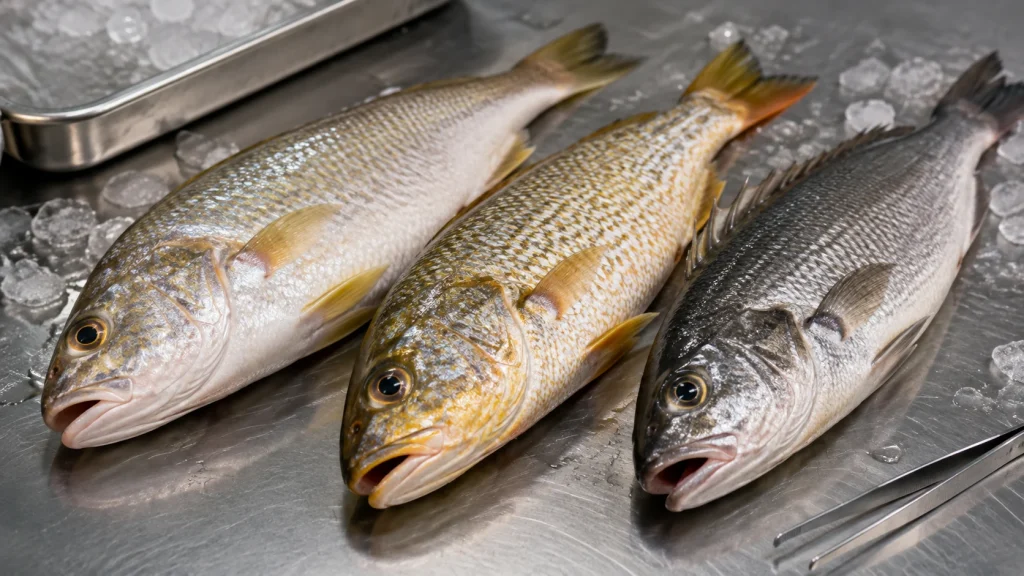
“Croaker fish” may sound like the name of one specific fish, but in fisheries biology and the seafood trade, the term is much broader. Croaker generally refers to fish in the family Sciaenidae, a large group that also includes species commonly known as drums, corvina, meagre, mulloway, weakfish, kingfish, and various regional names.
This distinction matters when buying, importing, processing, or specifying seafood. Two suppliers may both offer “croaker” while referring to different species with different sizes, appearances, origins, product formats, and market names.
FishBase lists about 300 species across 69 genera in the Sciaenidae family. Some are widely known as croakers, while others are rarely called croaker in the markets where they are sold. The most reliable way to know what you are actually purchasing is to check the scientific species name together with the origin and product specifications.
What is a croaker fish?
Croakers belong to the fish family Sciaenidae, often collectively known as croakers and drums.
The name comes from the sounds many members of this family can produce. Specialized muscles interact with the swim bladder to create croaking, drumming, or grunting sounds that can be used for communication and reproductive behavior.
Sciaenids share several anatomical features, although these vary between species. Many have a long dorsal fin with a noticeable division between the spiny and soft portions, a lateral line that continues onto the tail fin, sensory pores around the snout and jaw, and relatively large otoliths, or ear stones.
Some croaker species also have small barbels around the lower jaw or chin. Others do not, so barbels alone are not a reliable feature for identifying every croaker.
The family is also more diverse in habitat than the name might suggest. Sciaenids occur in marine and brackish environments, particularly coastal waters and estuaries, while some species also enter or live in freshwater.
Is croaker one species or a group of fish?
Croaker is better understood as a common-name category than as a precise scientific identification.
In some places, the word refers mainly to one familiar local species. In other countries, it may be used for several species within Sciaenidae.
This creates a clear difference between taxonomy and seafood terminology. Sciaenidae is the biological family, while “croaker” is one of several common names used for fish within that family.
Not every member of Sciaenidae is normally sold as croaker. Depending on the species and country, fish in the same family may instead be marketed as drum, corvina, meagre, mulloway, weakfish, or another local name.
The opposite problem also affects buyers. Seeing “croaker” on a seafood specification does not automatically tell you which Sciaenid species is being offered.
Which fish are actually called croaker?
Many different species legitimately appear under croaker-related common or market names.
The examples below show why the term should not be treated as a species-level identification.
| Species | Common or market name examples | Relevant market or region |
|---|---|---|
| Micropogonias undulatus | Atlantic croaker, croaker, hardhead | Western Atlantic, especially North America |
| Larimichthys crocea | Large yellow croaker, croaker | East Asia |
| Larimichthys polyactis | Small yellow croaker, redlip croaker, croaker | East Asia |
| Otolithes ruber | Tiger-toothed croaker, croaker | Indo-West Pacific |
| Johnius dussumieri | Croaker | South and Southeast Asian seafood trade |
| Protonibea diacanthus | Croaker, blackspotted croaker, ghol | Indo-Pacific and South Asian markets |
| Argyrosomus japonicus | Croaker, mulloway | Indo-Pacific; “mulloway” is standard in Australia |
| Argyrosomus regius | Meagre, croaker or shadefish in some market-name systems | Eastern Atlantic and Mediterranean |
| Various Cynoscion species | Croaker or corvina | Americas and seafood trade markets |
The U.S. FDA Seafood List is particularly useful for showing how much these names can overlap. Its seafood naming database permits “Croaker” as a market name for numerous Sciaenidae species, including fish from Johnius, Larimichthys, Otolithes, Pennahia, Protonibea, Pseudotolithus, Micropogonias, and other genera.
This does not mean every country uses those names in the same way. The FDA list applies to seafood naming in the United States, but it provides a clear example of how one market name can refer to many biological species.
Why Atlantic croaker dominates many English-language results
English-language information about croaker often focuses on the Atlantic croaker, Micropogonias undulatus.
This species is familiar enough in North American fisheries that “croaker” may be used as shorthand for Atlantic croaker when the geographic context is clear. Fisheries authorities in states such as Virginia and Maryland use Atlantic croaker as the established species name, while “hardhead” is another regional name.
Atlantic croaker typically has a projecting snout, a relatively low-positioned mouth, and small barbels around the chin. Reported maximum length is around 50 cm, although individuals around 30 cm are more typical.
Those features describe Micropogonias undulatus, not every fish sold or described as croaker.
This distinction can easily be missed when international seafood buyers rely on information written mainly around North American fisheries. A croaker sourced from Indonesia, India, China, or another Asian market may belong to a completely different genus.
Large yellow croaker and small yellow croaker are different species
Another common source of confusion appears in East Asian seafood terminology.
Large yellow croaker and small yellow croaker may sound like different commercial size grades of the same fish. They are actually separate species.
Large yellow croaker is Larimichthys crocea, while small yellow croaker is Larimichthys polyactis. Both are commercially important seafood species in East Asia, but the names should not be treated as interchangeable.
This is a good example of why descriptive English names can be misleading when purchasing seafood. Words such as “large,” “small,” “yellow,” or “red” may form part of an established species name rather than simply describing the fish’s size or appearance.
For procurement and product documentation, the scientific name removes much of that ambiguity.
Croaker names change between markets
A fish may belong to the croaker family without being sold as “croaker” in its main market.
Argyrosomus japonicus shows this clearly. The species may appear under croaker terminology in U.S. seafood naming systems, but in Australia its standard name is Mulloway.
Similarly, fish in the genus Cynoscion are widely known as corvina in parts of the Americas, even though they belong to Sciaenidae and may also appear under croaker-related market terminology elsewhere.
South Asian seafood trade provides further examples. India’s Marine Products Export Development Authority groups several species under croaker-related product names, including species of Johnius, while Protonibea diacanthus, another member of Sciaenidae, is commonly traded as ghol.
Common names therefore depend heavily on local fisheries, language, and trading conventions. Scientific names provide a more consistent way to identify the species.
Croaker identification can be especially complex in Indonesia
Indonesia adds another layer of complexity because local seafood names do not always correspond one-to-one with biological species.
Various sciaenids may be known locally by names such as gulamah, depending on the species and region. Recent taxonomic work also shows that identification within this group is still being refined.
In November 2025, researchers including scientists associated with BRIN and Museum Zoologicum Bogoriense formally described Johnius javaensis, or Java croaker, from southern Java. Its Indonesian common name was given as Gulamah Jawa.
The specimens were part of a reassessment of croaker material collected from fish markets in Java, Bali, and Lombok that had previously been identified as Johnius heterolepis. Researchers distinguished the new species using characteristics including mental barbels, fin and scale counts, and swim-bladder morphology.
For seafood businesses, this is a practical reminder that local market names may not provide enough certainty for international product specifications.
Why scientific names matter when buying croaker
For a retail customer buying a whole fish locally, the common name may be enough. For B2B seafood transactions, it often is not.
An importer asking for “croaker” could potentially receive products based on Otolithes ruber, Johnius dussumieri, Larimichthys crocea, or another Sciaenid species, depending on the supplier and origin.
The species can affect several commercial details, including expected body size, appearance, available cuts, sourcing region, buyer recognition, packaging information, and destination-market labeling.
A clearer specification normally includes:
- scientific name;
- commercial or local name;
- country or fishing origin;
- product form, such as whole round, gutted, headed and gutted, fillet, or another cut;
- size or weight grade;
- frozen or processing specification where relevant.
For an Indonesian supplier serving international buyers, using both scientific and commercial names can reduce confusion between local trade terminology and the terminology used in the destination market.
Can you identify a croaker just by looking at it?
Whole fish provide useful identification clues, but appearance alone is not always enough to confirm the species.
Fish identification may consider body profile, snout shape, mouth position, chin barbels, fin structure, lateral-line characteristics, coloration, scale patterns, and other anatomical features. Specialists may also count fin rays, scales, or other structures when closely related species are difficult to distinguish.
Color should be treated cautiously. Fish can change in appearance with age, handling, storage, preservation, and lighting, while closely related species may look similar enough to be confused in a market setting.
Identification becomes more difficult after a fish has been headed, filleted, skinned, or processed into frozen portions because many visible species characteristics are removed.
For commercial seafood, traceability and accurate supplier documentation become more important as the product moves further away from whole-fish form.
Common mistakes when using the name “croaker”
One common mistake is taking a fact about Atlantic croaker and applying it to all croakers. Statements about maximum size, habitat, fishing season, color, or body structure usually describe a specific species and region rather than the entire family.
The same caution applies to product characteristics. Taste, fillet size, yield, texture, nutritional composition, catch method, and sustainability status should not automatically be generalized across every fish called croaker.
Another mistake is assuming that similar common names refer to the same species. Large yellow croaker and small yellow croaker are separate species, while croaker, corvina, drum, mulloway, and meagre can refer to different members of the same family depending on the market.
For buyers, a more precise question is not simply “Do you supply croaker?” but “Which croaker species do you supply?”
Choosing the right croaker for seafood sourcing
No single species represents every commercial use of croaker.
The appropriate product depends on the species available from the sourcing region, buyer specifications, target-market naming requirements, desired size, processing format, and other commercial requirements.
For importers, distributors, retailers, and foodservice buyers working with suppliers such as Intan Seafood in Indonesia, confirming the scientific name early in the sourcing process can help prevent confusion between local trade terminology and the name expected in the destination market.
Croaker is a useful commercial term, but it should be the starting point for product identification rather than the final specification.
Conclusion
Croaker fish are primarily members of the Sciaenidae family, a diverse group containing roughly 300 species. However, “croaker” is not one universal species name, and many Sciaenids are better known as drums, corvina, meagre, mulloway, weakfish, ghol, or local names such as gulamah.
Species such as Atlantic croaker, large yellow croaker, small yellow croaker, tiger-toothed croaker, and several Johnius species can all appear under croaker terminology in different markets.
When species identity matters for sourcing, processing, labeling, or international trade, the scientific name should take priority over the common name. That is the clearest way to make sure a buyer and supplier mean the same fish when both use the word “croaker.”
References
- FishBase — Family Sciaenidae
- Transactions of the American Fisheries Society — Sciaenid Sound Production and Hearing
- U.S. FDA — The Seafood List
- Virginia Register of Regulations — Atlantic Croaker
- FAO AGRIS — Research on Large Yellow Croaker
- Marine Products Export Development Authority of India — Commercial Fish Species
- ITIS — Nibea soldado Taxonomic Record
- ScienceDirect — Description of Johnius javaensis from Indonesia