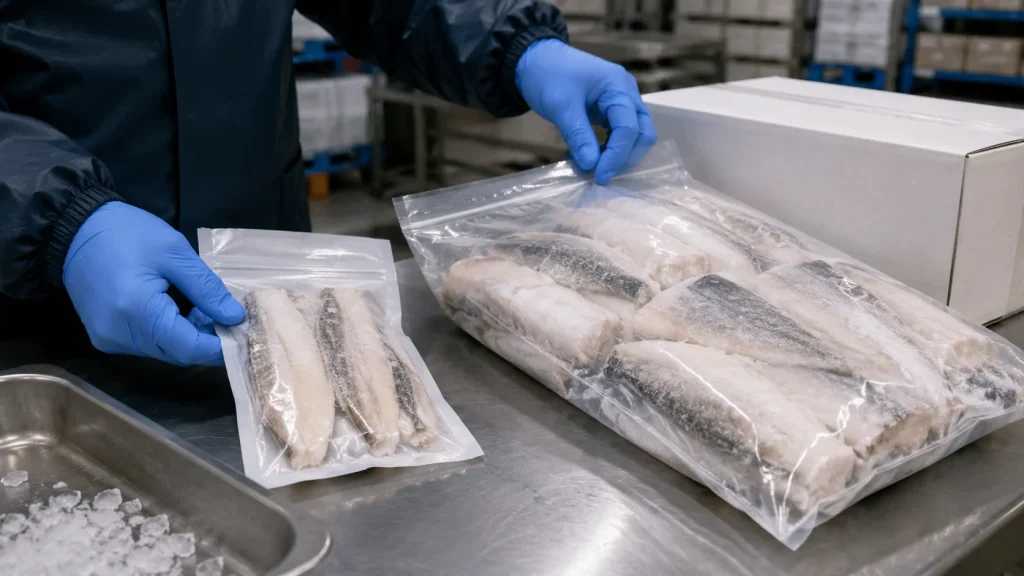
Private label frozen seafood involves much more than placing a company logo on a standard frozen product. Retailers, distributors, importers, and foodservice operators need to define exactly what they are buying, how consistently the processor can produce it, and whether the finished product meets the requirements of its destination market.
Decisions about species, cut, size, glaze, net weight, freezing method, packaging, labeling, traceability, food safety controls, certifications, and cold-chain handling should be settled before commercial production begins.
For this reason, a private label supplier should be evaluated as both a seafood processor and a supply-chain partner, rather than simply as a seller of frozen products.
Retail and foodservice require different product specifications
Retail and foodservice buyers may purchase the same species, but they often need different finished products.
A retail product has to work as a consumer-facing SKU. Depending on the market, the buyer may need a specific pack size, branded packaging, barcode, preparation and storage instructions, ingredient and allergen declarations, and other required labeling.
Foodservice buyers tend to focus more on operational consistency. A restaurant group, hotel supplier, caterer, or institutional distributor may care more about portion size, count per kilogram, usable yield, thawing performance, case configuration, and how easily individual pieces can be separated during preparation.
The differences are easier to see side by side:
| Consideration | Retail | Foodservice |
|---|---|---|
| Primary packaging | Consumer-facing branded pack | Bulk or operational pack |
| Typical priority | Shelf presentation and regulatory labeling | Portion consistency and kitchen efficiency |
| Pack configuration | Smaller retail units | Larger bags or master cases |
| Product consistency | Appearance, weight, labeling, cooking experience | Size, yield, portioning, preparation |
| Label focus | Consumer information | Case and lot identification |
| Buying concern | Sellable finished SKU | Predictable cost per portion |
Codex standards for quick-frozen seafood also distinguish between retail and non-retail containers. For non-retail products, some information may be provided through accompanying documents, while essential identification and storage information must remain associated with the shipment.
For buyers, this means “retail-ready” and “foodservice-ready” should be treated as separate specifications, even when both products start with the same raw material.
Start with the seafood specification, not the packaging
One common mistake in a private label project is discussing bags, boxes, or artwork before fully defining the product itself.
A useful seafood specification should clearly identify the species and product form. Depending on the product, it may also define the scientific name, cut, skin-on or skinless condition, bone status, size or count range, raw or cooked condition, freezing method, glaze, additives or treatments, net weight, packaging configuration, storage conditions, and acceptable tolerances.
This becomes especially important when comparing quotations from several suppliers.
Two suppliers may quote different prices per kilogram for what appears to be the same fish, while actually offering different size ranges, glaze percentages, treatments, specifications, or usable yields. A lower price per kilogram does not necessarily mean a lower final cost once the product is thawed and prepared.
Private label purchasing is therefore easier to compare when every supplier quotes against the same written specification rather than a broad request such as “frozen fillet, 1 kg pack.”
Glaze affects both product protection and actual cost
Glazing is widely used in frozen seafood because a thin layer of ice helps protect the product surface from dehydration during frozen storage. However, the glaze must be distinguished from the weight of the seafood itself.
Codex defines glazing as a protective layer of ice formed on frozen seafood. For glazed products, the declared net contents are expected to exclude the glaze.
The U.S. Food and Drug Administration has also stated that counting ice glaze as part of the declared seafood net weight can result in a misbranded product.
This has a direct commercial effect. Buyers should not compare products only by gross frozen weight because different glaze levels can change how much seafood they are actually purchasing and how much usable product remains after thawing.
For foodservice buyers, yield may be more useful than headline case weight when comparing offers. Retailers also need to make sure the declared quantity complies with the labeling rules of the destination market.
Freezing and cold-chain control affect final product quality
Frozen seafood can leave a processing facility in good condition and still lose quality if temperature control fails during storage or transport.
Codex guidance describes quick freezing as a process that brings the product to −18°C or colder at its thermal centre after thermal stabilization. Codex guidance for fish and fishery products also recommends keeping frozen products at −18°C or below during storage and transportation while minimizing temperature fluctuations.
Poor temperature control can contribute to dehydration, freezer burn, texture changes, and other quality problems, especially when packaging, glazing, storage, or distribution conditions are inadequate.
FDA consumer guidance also notes that excessive frost or ice crystals can sometimes indicate long storage or that frozen seafood has thawed and been refrozen.
A supplier evaluation should therefore go beyond checking whether the company has cold storage. Buyers may also need to review the freezing method, cold-storage controls, loading procedures, temperature monitoring, packaging protection, and the handover process between the processor and logistics provider.
Food safety requirements depend on the destination market
Private label seafood is often traded internationally, so no single certification or compliance statement applies to every market.
For seafood entering the United States, fish and fishery products are regulated under the FDA seafood HACCP requirements in 21 CFR Part 123. These requirements also apply to imported seafood.
Where the relevant regulatory arrangements do not provide an alternative, U.S. seafood importers must use written verification procedures and appropriate affirmative steps to verify that products from foreign processors were produced in accordance with the applicable seafood HACCP requirements.
This is more specific than simply asking whether a factory is “HACCP certified.” Buyers need to understand which requirements apply to the processor, product, importer, and destination market.
Third-party schemes such as BRCGS, SQF, or FSSC 22000 may also matter commercially because some retailers and brand owners include them in supplier approval requirements. However, they should not be described as universal legal requirements for every private label seafood transaction.
A better supplier check is whether the certification scope covers the actual facility, process, and product being purchased, and whether it meets the requirements of the buyer or its customer.
Traceability is becoming a bigger part of seafood sourcing
Traceability matters for product control, recalls, and regulatory compliance. It is also becoming more detailed in major seafood markets.
In the United States, the FDA Food Traceability List includes categories of finfish, crustaceans, and bivalve molluscan shellfish, including frozen products. The Food Traceability Rule establishes recordkeeping requirements based on key data elements, critical tracking events, and traceability lot codes.
The original compliance date was January 20, 2026. FDA now states that Congress has directed the agency not to enforce the rule before July 20, 2028 while implementation issues and possible flexibilities are being considered.
The European Union has also expanded digital traceability requirements for fishery and aquaculture products. Relevant lot-level requirements under the revised fisheries control regime became applicable to certain fresh and frozen products on January 10, 2026. Additional requirements for some processed products are scheduled for January 10, 2029.
For buyers sourcing internationally, lot identification, supplier records, shipment documentation, and recall capability should therefore be part of the supplier review process.
Confirm species names and labels before printing
Seafood names are not always interchangeable between markets. A commercial name commonly used by a supplier may not be accepted on consumer packaging in the destination country.
In the United States, FDA maintains the Seafood List, which includes acceptable market names, common names, and scientific names for seafood sold in interstate commerce. The list was updated in January 2026.
U.S. allergen rules also require packaged foods containing fish or Crustacean shellfish to identify the specific fish or crustacean source rather than using only a broad category such as “fish.”
European requirements differ. For fishery and aquaculture products covered by EU consumer-information rules, labeling may need to state the commercial and scientific species name, production method, catch or production area, fishing-gear category for captured products, and whether the product has been defrosted, subject to applicable exceptions.
For private label projects, the destination market should therefore be confirmed before the packaging artwork receives final approval. Printing a large quantity of packaging before regulatory review can turn a labeling error into an expensive inventory problem.
Sustainability labels come with certification requirements
Retail and foodservice buyers may request certification marks such as MSC for wild-caught seafood or ASC for farmed seafood.
These are controlled certification schemes, not general sustainability symbols that can be added freely to packaging.
MSC requires appropriate Chain of Custody controls through the supply chain, along with licensing and product-registration requirements for products that use its label. Its guidance also addresses how the relevant Chain of Custody code is handled when a processor packs a private label product.
ASC uses the MSC Chain of Custody framework together with additional ASC requirements for certified farmed seafood. Use of the ASC label is also subject to the applicable licensing requirements.
Buyers requesting certified private label seafood should confirm that the product is eligible, the processing site is covered by the required chain-of-custody arrangements, and the certification mark can be used on the intended SKU.
Indonesia can supply international private label programs
Indonesia already has a substantial role in international seafood trade. Indonesia’s Ministry of Marine Affairs and Fisheries, or KKP, reported fishery-product exports worth USD 6.27 billion in 2025, up 5.2% from 2024.
The United States accounted for 31.8% of the reported export value, followed by China at 19.5%, ASEAN markets at 16.0%, Japan at 9.8%, and the European Union at 7.2%. Shrimp represented 29.8% of Indonesia’s fishery export value.
These figures show the scale of Indonesia’s seafood exports, but they do not mean every processor is qualified for every market.
Facility-level controls still matter. Indonesia uses systems including Sertifikat Kelayakan Pengolahan (SKP), which is associated with processing-facility suitability and GMP requirements, together with HACCP-based controls and export health certification administered through the fisheries quality system.
KKP reported in March 2026 that its seafood health-certification system supported exports to 140 trading-partner countries.
For an overseas buyer, the relevant question is not simply whether the seafood comes from Indonesia. The actual processing facility, documentation, certification, and shipment must be able to meet the requirements of the intended destination.
How to evaluate a private label frozen seafood supplier
Price and MOQ matter, but they should not be the only criteria used to compare suppliers.
A private label program is easier to manage when the buyer and processor agree on the finished product before commercial production begins. That requires a clear specification and an understanding of how the supplier manages the product through sourcing, processing, freezing, packaging, storage, and shipment.
Before approving a supplier, buyers should normally clarify:
- the exact species and product form;
- cut, size, count, and acceptable tolerance;
- glaze level and declared net weight;
- raw, cooked, treated, or untreated condition;
- freezing method and storage requirements;
- retail or foodservice packaging configuration;
- destination-market labeling responsibility;
- lot identification and traceability;
- HACCP and export documentation;
- third-party certifications required by the customer;
- shelf-life basis and storage conditions;
- approval of pre-production or production samples;
- procedures for substitutions and out-of-spec products;
- cold-chain and logistics responsibilities.
There is no reliable universal “standard MOQ” or private label production lead time for frozen seafood. These conditions depend on the species, season, raw-material availability, processing method, packaging, print quantity, destination, and individual supplier.
A quotation should therefore be reviewed together with the product specification, expected yield, documentation, packaging, and logistics requirements rather than judged only by price per kilogram.
Choosing the right private label setup
A well-defined private label frozen seafood program gives the buyer and processor the same understanding of what will be produced and delivered.
For retailers, that often means a compliant, consumer-ready SKU with consistent product quality, correct labeling, suitable packaging, and dependable supply. For foodservice buyers, the emphasis may shift toward portion consistency, usable yield, preparation efficiency, bulk packaging, and predictable availability.
For companies sourcing from Indonesia, working with a processor that can coordinate sourcing, processing, quality control, cold storage, packaging, private label requirements, and export logistics can make the supply chain easier to manage. The final decision should still depend on whether the supplier can meet the exact product specification and regulatory requirements of the target market.
The most useful comparison is not simply which supplier offers the lowest price per kilogram. Buyers should compare which supplier can consistently deliver the required seafood, specification, documentation, packaging, traceability, and cold-chain performance.
References
- Codex Code of Practice for Fish and Fishery Products
- FAO Guidance on Freezing and Glazing in Fish Value Chains
- FDA Seafood HACCP and Foreign Processor Requirements
- FDA Food Traceability List
- FDA Seafood List
- MSC Brand and Label Guidelines
- BRCGS Information for Brand Owners
- Indonesia Ministry of Marine Affairs and Fisheries Licensing and Processing Information