


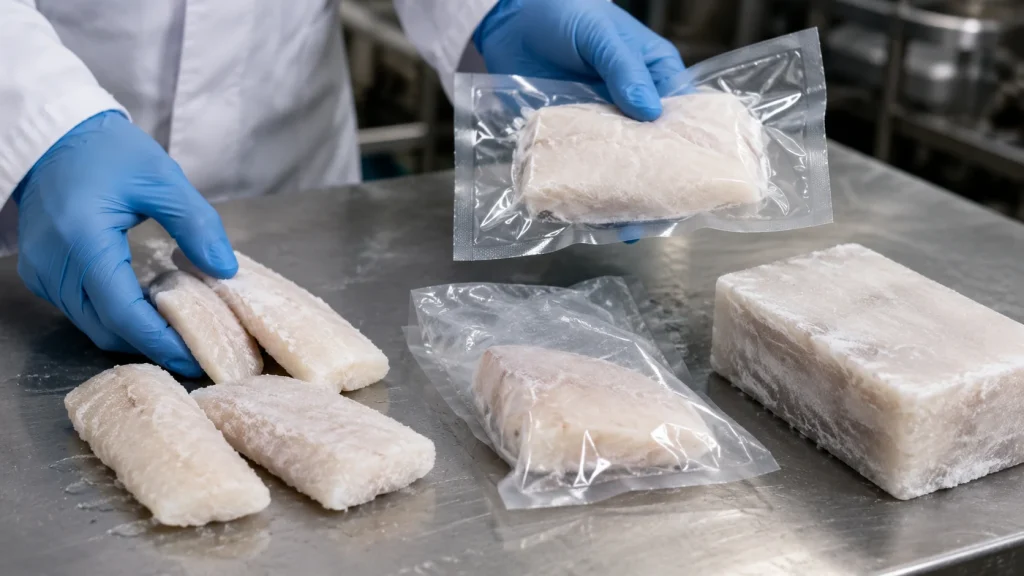
Choosing between IQF, IVP, IWP, and block-frozen seafood is not simply a matter of deciding which format is better. The right choice depends on what happens after the carton arrives: whether you need individual portions, whether the entire pack will be processed at once, how much handling is involved, and how the product will eventually be sold or served.
There is also a terminology issue. IQF and block mainly describe how seafood is frozen and presented, while IVP and IWP describe how individual pieces are packaged. A product can therefore be both IQF and IVP.
For buyers, the more useful question is not “IQF or IVP?” but which combination of freezing method and packaging best fits the product, operation, and target market.
IQF, IVP, IWP, and block do not describe the same thing
These terms are often placed side by side in supplier quotations, but they are not four versions of the same classification.
IQF, or Individually Quick Frozen, means individual pieces are frozen separately so they remain separable after freezing. FAO guidance describes IQF products as individual fish, fillets, or portions that can be removed from the frozen pack in the quantity required.
Block-frozen seafood, by contrast, is frozen as a coherent mass. Codex has a dedicated standard for quick-frozen blocks of fish fillets and minced fish flesh, products that are commonly intended for further processing.
IVP normally means Individually Vacuum Packed. Each piece is packed separately under vacuum.
IWP is commonly used for Individually Wrapped Pack or Individually Wrapped Packed products. However, unlike Codex definitions for certain frozen product forms, IWP does not have one universal seafood-industry definition. Suppliers may use different wrapping materials and sealing methods, so buyers should confirm what the specification actually includes.
This distinction matters because a fillet can be IQF first and then individually vacuum packed. “IQF + IVP” is therefore a valid specification, not a contradiction.
| Format | What it mainly describes | Typical advantage | Common fit |
|---|---|---|---|
| IQF | Freezing/presentation | Pieces remain individually separable | Foodservice, distribution, portion-controlled use |
| IVP | Individual vacuum packaging | Each portion has its own reduced-air package | Retail, foodservice, portion-controlled programs |
| IWP | Individual wrapping | Separate physical protection for each piece | Retail, distribution, foodservice |
| Block | Bulk frozen presentation | Dense, efficient bulk handling | Processing operations using larger quantities at once |
In practice, a buyer may need to choose both a freezing method and a packaging format rather than selecting just one term from this table.
When IQF makes the most sense
IQF is particularly useful when the buyer does not expect to use an entire carton at once.
Because the pieces remain separate, a restaurant, distributor, processor, or repacking operation can remove only the quantity needed while leaving the rest frozen. This can make portion control easier and reduce the need to thaw a larger frozen mass just to use a few pieces.
Codex standards for quick-frozen fish fillets state that quick freezing should pass rapidly through the zone of maximum ice crystallization and continue until the product reaches a temperature of -18°C or colder at the thermal centre after stabilization.
However, the letters “IQF” alone do not guarantee better eating quality. Research on frozen seafood shows that final quality can also depend on the condition of the raw material, species, freezing rate, storage temperature, temperature fluctuations, dehydration, packaging, and thawing conditions.
An IQF specification therefore tells the buyer something important about how the product is frozen and handled, but it is not a complete quality specification.
IQF is generally a good fit when:
- individual pieces need to be taken from the carton repeatedly;
- portion sizes matter;
- the buyer needs flexibility in kitchen or production use;
- products will be repacked into smaller quantities; or
- thawing a whole bulk unit would create unnecessary handling or waste.
For buyers who routinely process the full contents of a pack at once, some of those advantages may offer little practical value.
When block-frozen seafood can be the better choice
Block frozen is sometimes presented as an outdated or lower-quality alternative to IQF, but that comparison is too simplistic.
Codex specifically recognizes quick-frozen blocks of fish fillet, minced fish flesh, and mixtures of fillets and minced fish. A seafood product can therefore be quick frozen while still being produced as a block.
FAO guidance also notes that blocks can be produced in plate freezers, creating regular shapes that can be stored efficiently. Block formats are particularly relevant when the seafood is intended for further processing rather than individual piece-by-piece withdrawal.
A processor making breaded products, portions, minced products, or other secondary seafood products may expect to thaw or process an entire production unit. In that situation, paying for individual separation or individual packaging may provide little operational benefit.
The main trade-off is flexibility. If a buyer needs only part of a block, separating frozen pieces can be difficult or impractical without thawing more product than required.
The choice therefore depends more on production flow than on a simple quality ranking. Block can make sense for high-volume processing, while IQF is usually more convenient when individual pieces need to remain accessible.
Where IVP fits into the decision
IVP describes packaging rather than the basic freezing format.
With Individually Vacuum Packed seafood, each portion is enclosed in its own reduced-air package. Vacuum packaging can help limit exposure to oxygen, and research on frozen fish has found lower oxidative deterioration in vacuum-packed samples than under some non-vacuum packaging conditions.
Individual packs can also make portions easier to distribute, protect, count, and handle separately. This can be useful for portion-controlled foodservice programs, retail products, or buyers who want each fillet or steak individually contained.
The extra packaging does not automatically make IVP the right choice for every application. It adds material and packing requirements, and buyers who will immediately unpack large quantities for further processing may gain little from individually vacuum-sealed portions.
Reduced-oxygen packaging also requires proper handling. In the United States, FDA guidance identifies Clostridium botulinum as a hazard that requires attention in certain reduced-oxygen-packaged fish products. The 2022 FDA Food Code states that fish packaged in reduced oxygen and labeled to remain frozen until use should be removed from that reduced-oxygen environment before refrigerated thawing, or before or immediately after thawing under permitted running-water conditions.
That is a US-specific regulatory example, not a universal requirement for every destination market. Importers and distributors should verify the rules that apply where the seafood will be sold.
IWP needs a clearer supplier specification
IWP may sound straightforward, but the acronym alone tells a buyer less than many quotation sheets suggest.
In seafood trade usage, it generally refers to individual pieces placed in separate plastic wrapping or bags. However, there is no single universal technical definition that establishes exactly what material, sealing system, or oxygen barrier every IWP product must use.
An individually wrapped fillet should therefore not automatically be treated as equivalent to an individually vacuum-packed fillet.
When a supplier offers IWP, buyers should clarify details such as:
- whether each unit is fully sealed or simply wrapped;
- the type of inner packaging material;
- whether the product is IQF before wrapping;
- whether the wrap is intended mainly for physical separation or also provides barrier protection; and
- how many individually wrapped pieces are packed in each master carton.
For retail and foodservice programs, these details can affect handling, presentation, storage, and repacking requirements.
Do not compare quotations without checking glaze and net weight
For many IQF seafood products, the freezing format is only part of the cost calculation. Glazing can materially affect how much seafood is actually contained in a carton.
Glaze is a protective coating of ice applied to frozen seafood. FAO guidance recognizes glazing as a way to help protect frozen fish from dehydration and freezer burn.
Glaze itself is not necessarily a problem. The issue is whether protective ice is being counted and priced as seafood.
For glazed products, Codex and regulatory guidance distinguish the product’s net content from the weight of the glaze. In the United States, the FDA released results in September 2025 from a frozen-seafood short-weighting sampling assignment conducted from 2022 to 2024. Ten of 28 imported retail samples were found to be violative, with shortages ranging from 2.3% to 9.9%.
That small and partly targeted sample should not be interpreted as evidence that 36% of imported seafood is short weighted. It does, however, show why buyers should verify what a quoted kilogram actually represents.
European Commission guidance similarly states that when food is glazed, the declared net weight should exclude the glaze.
A cheaper price per carton may therefore be less attractive once the actual deglazed product weight is taken into account.
Compare cost per usable kilogram, not only price per kilogram
A quotation becomes more useful when buyers evaluate how much saleable or usable seafood remains after normal handling.
The calculation may need to account for:
- declared net seafood weight;
- actual deglazed weight;
- thaw yield and drip loss;
- portion size and consistency;
- individual packaging costs;
- labor required for unpacking or portioning;
- repacking requirements; and
- how much product must be thawed for each production cycle.
There is no reliable universal rule that block is always cheapest, IQF always costs more, or IVP is always the most expensive option. Species, cut, size, country of origin, order volume, processing requirements, packaging material, glaze, and commercial terms can all affect the quotation.
A higher-priced format may still produce a lower practical cost if it reduces unnecessary thawing, portioning labor, product loss, or repacking. On the other hand, a processor that consumes whole bulk units may gain little from paying for individually packed pieces.
The most useful comparison is based on the buyer’s actual operation.
Specify freezing and packaging separately in the RFQ
One of the simplest ways to prevent confusion is to avoid using a single acronym as the entire product specification.
Instead of requesting only “IVP snapper,” a buyer can specify the seafood and the required format in separate fields.
A practical specification may include:
- species;
- cut or product form;
- size or weight range;
- freezing method;
- glaze requirement;
- individual packaging format;
- net weight per carton;
- additives or treatment requirements where relevant;
- labeling requirements;
- destination-market requirements; and
- required certifications.
For example, a quotation might describe a snapper fillet by species and size, followed by “IQF, each portion IVP,” together with the agreed net carton weight and glaze specification.
That gives the processor considerably more information than either “IQF” or “IVP” alone.
USDA procurement specifications provide a useful example of this separation. Its January 2026 fish and fishery-products requirements distinguish individually glazed portions from individually vacuum-packed portions and require frozen products to be stored at 0°F, approximately -18°C, or below.
International buyers may work under different commercial or regulatory requirements, but the procurement principle is broadly useful: define the product, freezing method, packaging, and measurable specifications separately.
Ask for samples before deciding on format
Two products carrying the same acronym can still perform differently.
Before approving a large order or long-term specification, representative samples allow buyers to check how the product performs under their own handling conditions.
Useful checks can include deglazed net weight, separation of pieces while frozen, package and seal condition, piece size, thaw yield, drip loss, appearance, and texture after the buyer’s normal thawing or cooking process.
For glazed products, the method used to remove the glaze also matters. Codex procedures describe controlled deglazing so the protective ice is removed while the seafood itself remains frozen before weighing. Simply allowing seafood to thaw and then weighing it can combine glaze loss with natural thaw loss and give a misleading result.
Sample evaluation is especially useful when suppliers use terms such as IWP differently, or when two quotations look similar on paper but use different glaze, portioning, or packaging specifications.
So, which frozen seafood format should buyers choose?
There is no single format that suits every seafood buyer.
Choose IQF when individual piece access and portion flexibility are important. Consider block-frozen products when entire units will normally be thawed or processed together. Choose IVP when each piece needs its own vacuum package for handling, protection, or portion-controlled distribution. Consider IWP when individual wrapping is useful, but confirm exactly what the supplier means by the term.
In many cases, the final specification is a combination rather than a single acronym. A buyer may need an IQF product supplied in IVP, an IQF product in simpler individual wrapping, or a block format intended for further processing.
For importers, distributors, retailers, foodservice operators, and processors sourcing from suppliers such as Intan Seafood in Indonesia, a useful RFQ should specify the freezing method, packaging format, glaze, net weight, product size, and downstream requirements separately. This makes quotations easier to compare and reduces the risk of choosing a format that looks suitable on paper but does not fit the way the seafood will actually be used.
References
- FAO Fisheries Technical Guidance on Freezing and Frozen Fish
- Codex Standard for Quick-Frozen Fish Fillets
- Codex Standard for Quick-Frozen Blocks of Fish Fillet, Minced Fish Flesh and Mixtures
- Review of Quality Changes in Frozen Fish
- FDA Fish and Fishery Products Hazards and Controls Guidance
- FDA Results on Economically Motivated Adulteration and Short Weighting in Seafood
- European Commission Guidance on Net Quantity and Glazed Foods
- USDA Supplement 512: Fish and Fishery Products, January 2026


