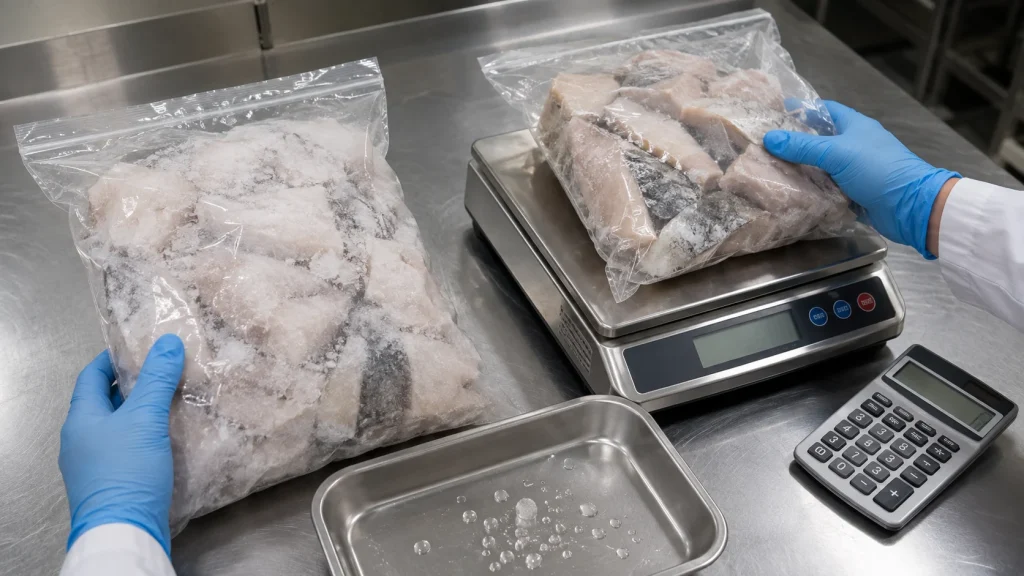
Two frozen seafood quotes can describe similar products, show the same carton weight, and still be difficult to compare fairly. The reason is that part of the quoted weight may be protective ice glaze rather than seafood.
For importers, distributors, retailers, and foodservice buyers, comparing only the quoted price per kilogram can therefore lead to the wrong purchasing decision. A product that looks cheaper per glazed kilogram may cost more once the ice is removed.
A better approach is to confirm exactly what each supplier means by glaze percentage and net weight, then compare all offers on the same basis: the cost per kilogram of deglazed seafood that meets the agreed specification.
Start by checking what the quoted kilogram represents
Before doing any calculations, confirm whether the supplier’s price is based on:
- deglazed net seafood weight;
- glazed seafood weight;
- carton weight; or
- another commercial weight stated in the quotation.
This distinction changes the calculation completely.
International standards generally treat glaze separately from the declared net content of glazed frozen seafood. Codex standards for products such as quick-frozen shrimp and frozen fish specify that net contents for glazed products should exclude the glaze.
Similar principles apply in several major importing markets. Regulations and official guidance in the EU, UK, Canada, and the US generally distinguish the actual seafood content from protective ice when determining declared net quantity.
However, a supplier quotation is a commercial document, not automatically a regulatory net-weight declaration. A price listed as “USD 6.00/kg” still needs a clearly stated weight basis.
If a supplier is genuinely quoting USD 6.00 per kilogram of deglazed net seafood, there is no need to deduct the glaze percentage from that price again. The commercial kilogram already represents seafood excluding the glaze.
If USD 6.00/kg refers to the glazed product weight, however, the quote needs to be normalized before it can be compared with a net-weight offer.
Compare quotes using the cost per kilogram of deglazed seafood
Assume the supplier defines glaze percentage as:
glaze weight ÷ total glazed product weight × 100
Under this definition, a product with 20% glaze contains 80% seafood by weight after the surface glaze is removed.
The comparable net seafood price is:
price per glazed kg ÷ net seafood fraction
For example:
USD 6.00 ÷ 0.80 = USD 7.50/kg net seafood
A quote of USD 6.00/kg glazed therefore represents an effective cost of USD 7.50 for each kilogram of deglazed seafood received.
The difference becomes clearer when two suppliers are compared.
| Supplier | Quoted price | Glaze | Net seafood fraction | Equivalent price per net kg |
|---|---|---|---|---|
| Supplier A | USD 5.20/kg glazed | 20% | 80% | USD 6.50 |
| Supplier B | USD 5.50/kg glazed | 10% | 90% | USD 6.11 |
Supplier A initially appears cheaper because its quoted price is USD 0.30/kg lower. After adjusting for glaze, Supplier B has the lower cost per kilogram of deglazed seafood.
This is why unit price or carton price alone is not enough when suppliers use different glaze specifications.
A stated glaze percentage is not enough
One of the easiest details to overlook is that “20% glaze” can mean different things depending on how the percentage is calculated.
Codex methodology for glazed frozen fish includes calculations using either glazed product weight or deglazed product weight as the denominator. Those two methods do not produce the same result.
Suppose a glazed seafood lot weighs 10 kg.
If glaze is defined as 20% of the total glazed product weight, then:
- glazed product weight = 10 kg;
- glaze = 2 kg;
- deglazed seafood = 8 kg.
If glaze weight is instead defined as 20% of the deglazed seafood weight, the calculation changes:
glaze weight = net seafood weight × 20%
Under that definition, a 10 kg glazed lot contains approximately 8.33 kg of seafood and 1.67 kg of glaze.
Both could loosely be described as “20% glaze,” even though the amount of seafood is different.
A purchase specification should therefore define the formula rather than asking only for a percentage. For example:
Glaze % = (glazed product weight − deglazed product weight) ÷ glazed product weight × 100
Once all suppliers use the same definition, their prices become much easier to compare.
Do not confuse gross weight, glazed weight, and net weight
Terms such as gross weight and net weight can also cause confusion because their meaning depends on the document or test method being used.
In logistics, gross carton weight normally refers to the complete shipping unit. It can include the seafood, glaze, inner bags, liners, and master carton.
A buyer may therefore see several different weights for the same carton:
- total carton or shipping gross weight;
- glazed seafood weight without packaging;
- deglazed net seafood weight.
Technical testing documents may use the same terms differently. In one Codex deglazing method, for example, “gross weight” refers to the glazed seafood after the package has already been removed, while net weight refers to the product after deglazing.
For procurement purposes, writing out the exact meaning is safer than relying only on abbreviations such as GW and NW.
If Supplier A reports a 10 kg “net weight” while Supplier B reports 10 kg “glazed weight,” those figures should not be compared until both definitions have been confirmed.
Check how the supplier verifies deglazed net weight
Calculating seafood content from a stated glaze percentage is useful when reviewing quotations, but a purchase specification also needs a practical method for checking the actual shipment.
Deglazing is more controlled than simply thawing the seafood and weighing what remains.
Codex procedures for glazed frozen fish are designed to remove the surface ice while minimizing thawing of the seafood itself. The frozen product is exposed to cold water until the glaze has been removed, adhering water is allowed to drain, and the product is then weighed.
The method matters because excessive thawing may cause tissue drip to leave the seafood. The measured weight could then fall below the actual weight of the frozen product after glaze removal.
Incomplete deglazing creates the opposite problem. Residual ice remains on the seafood and makes the measured net weight appear higher than it should.
For buyers sourcing from several suppliers or countries, agreeing on a deglazing method before shipment can reduce disputes over whether the product meets the contracted net-weight specification.
One sample bag may not represent the whole shipment
Checking a single pouch can give a rough indication of glaze level, but it provides limited evidence about whether an entire commercial lot consistently meets the declared weight.
Formal inspection systems use sampling plans instead of assuming that one package represents thousands of others. The 2026 edition of the US National Institute of Standards and Technology’s Handbook 133, for example, uses larger samples as the inspection lot increases.
Under its Category A plan, lots of 12 to 250 packages use a 12-package sample, lots of 251 to 3,200 packages use 24, and larger lots use 48.
The handbook also makes an important distinction about quantity tolerances. Package-control rules do not simply allow every package to be slightly underfilled. The average quantity of the inspected lot must meet the declared quantity, while individual packages are also subject to limits on unreasonable shortages.
A commercial seafood contract does not necessarily need to copy a US regulatory sampling plan, especially when the shipment is destined for another market. The broader procurement principle is more useful: define how many units will be checked, how they will be selected, how the glaze will be removed, and what result will count as acceptance.
Short weight is a real commercial risk
Glaze and net weight are not only accounting issues. Short-weighting can directly affect the amount of seafood a buyer actually receives.
On September 2, 2025, the US Food and Drug Administration reported results from imported frozen seafood samples collected between 2022 and 2024 as part of its work on economically motivated short-weighting.
FDA tested 28 imported retail frozen seafood samples and reported that 10, or 36%, were violative for short weight. The deficiencies ranged from 2.3% to 9.9%, and the affected shipments were refused entry.
Those figures should not be treated as the prevalence of short-weighting across the global seafood industry. The sample was small, specific to FDA’s testing activity, and limited to particular imported retail products.
They do, however, show why weight specifications should be treated as measurable purchasing criteria rather than relying only on supplier descriptions or nominal carton weights.
More glaze does not automatically mean worse seafood
A comparison based on net weight should not lead to the assumption that all glaze is undesirable.
Glazing has a practical purpose in frozen seafood. The ice layer helps reduce dehydration and oxidation while the product remains in frozen storage.
The appropriate amount can vary depending on the species, product shape and surface area, processing method, glazing conditions, storage period, and distribution requirements.
Research has therefore produced different glaze levels for different situations. One controlled shrimp study found that glaze uptake of around 15% to 20% performed effectively under the specific storage conditions tested over 180 days. Other seafood products and commercial conditions may require different levels.
There is no single glaze percentage that should automatically be treated as ideal for every fish fillet, shrimp, squid product, or frozen portion.
For buyers, the more useful question is whether the glaze is suitable for the product and supply chain, accurately declared, consistently controlled, and excluded from the commercial net seafood weight where required.
Size grades can also depend on deglazed weight
Glaze can affect more than the apparent price per kilogram.
For shrimp and other seafood commonly sold by count or size grade, buyers should also check the weight basis used for sizing. Under the Codex standard for quick-frozen shrimp or prawns, when count per unit weight is declared, the count is determined using the actual deglazed weight.
This matters when comparing offers such as 21/25, 26/30, or other count-based shrimp sizes. Two suppliers should not be treated as offering the same specification if they use different weight bases to determine the count.
The RFQ should therefore align the product-size definition with the deglazing and net-weight specifications so that price, physical size, and delivered seafood quantity are all being compared on the same basis.
Glaze percentage does not measure all water in the product
Surface glaze should also be distinguished from water retained inside or associated with the seafood.
Deglazing removes the external ice coating. It does not automatically measure the effects of processing treatments, retained moisture, or permitted ingredients used for moisture retention.
Codex seafood standards allow certain additives or moisture-retention treatments in applicable product categories. Their use and declaration depend on the product and destination market.
The EU also has specific labeling requirements for certain fishery products containing more than 5% added water.
A low glaze percentage therefore does not automatically guarantee better thaw yield or cooking yield. If yield matters commercially, the product’s treatment and ingredient specifications should be reviewed separately from its glaze level.
What should be included in a comparable seafood RFQ?
The easiest way to avoid recalculating unclear quotations is to make the RFQ more precise before suppliers submit their prices.
For each product, buyers should consider requesting:
- exact species and product form;
- cut, size, count, or grading specification;
- treatment or relevant additive specification;
- target glaze percentage;
- formula used to calculate glaze percentage;
- deglazed net seafood weight per inner pack;
- deglazed net seafood weight per master carton;
- glazed product weight where relevant;
- total shipping gross weight where relevant;
- whether the price is quoted per glazed kg or net kg;
- agreed deglazing test method;
- sampling and acceptance criteria;
- packaging configuration; and
- the same Incoterm and freight scope for every offer being compared.
Using the same specification across suppliers makes the purchasing decision clearer. Price can then be normalized to the cost per kilogram of conforming deglazed seafood, while factors such as quality, size consistency, packaging, treatments, logistics, payment terms, and expected yield can be evaluated separately.
For international buyers sourcing frozen fish, tuna, squid, or other seafood from Indonesia, this level of detail is particularly useful when comparing processors that offer different cuts, sizes, packaging formats, glaze levels, and private-label specifications.
The cheapest quote may not have the lowest seafood cost
A frozen seafood quote becomes meaningfully comparable only when you know what its kilograms represent.
If the quoted price is already based on deglazed net seafood weight, compare it directly with other net-weight offers. If the price is based on glazed weight, convert it to an equivalent net-seafood price using the supplier’s clearly defined glaze formula.
Then confirm that gross weight, glazed product weight, deglazed net weight, size grade, treatments, and inspection methods mean the same thing across all competing offers.
That gives buyers a more useful basis for comparison than the headline carton price: the actual cost of the seafood they intend to buy.