


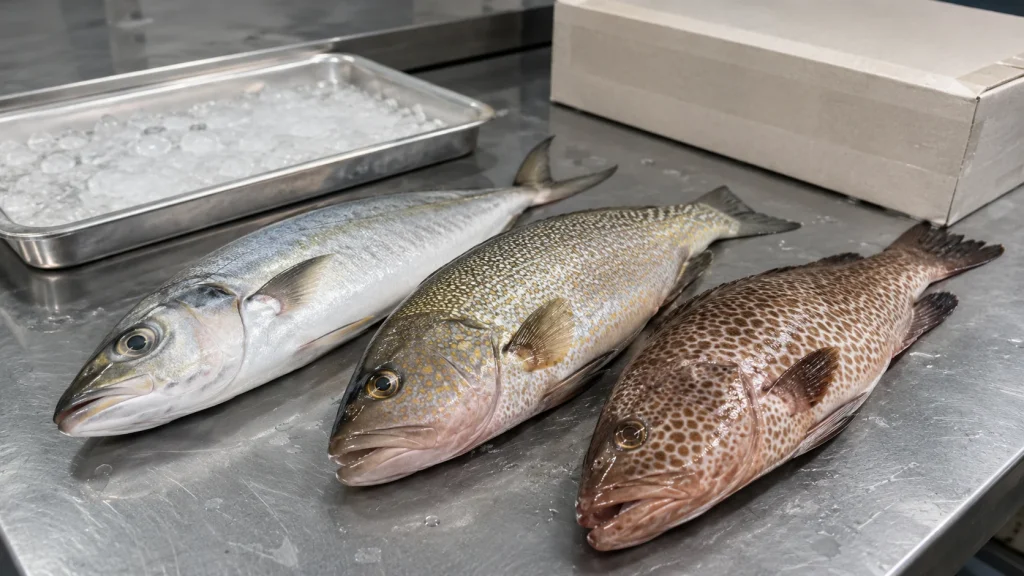
A buyer asking for “kingfish” may receive very different seafood depending on where the supplier is located. In Australia or New Zealand, the name commonly refers to Yellowtail Kingfish, Seriola lalandi. In parts of the Gulf, “king fish” can mean Narrow-barred Spanish Mackerel, Scomberomorus commerson. In the United States, the FDA accepts “Kingfish” as a market name for several Menticirrhus species, while King Mackerel refers to Scomberomorus cavalla.
All of these names can be valid within their own markets. Problems arise when a regional common name is treated as though it identifies the same species everywhere.
For importers, distributors, retailers, foodservice buyers, and seafood processors, this is more than a naming issue. Species can affect product characteristics, specifications, labeling, customer expectations, and regulatory requirements. A seafood quotation that says only “kingfish” may therefore leave out one of the most important details.
Kingfish is a market name, not one universal species
Fish names developed locally, often long before seafood became part of an international supply chain. As a result, the same species may have several names, while one common name may be used for several different species.
Australia’s Fisheries Research and Development Corporation identifies this as one reason standardized fish naming became necessary. The Australian Fish Names Standard now covers thousands of species and assigns standardized names intended to reduce confusion in seafood trade and communication.
“Kingfish” shows the problem particularly clearly because the name can refer to fish from entirely different taxonomic groups.
| Market or region | “Kingfish” may refer to | Scientific name | General fish group |
|---|---|---|---|
| Australia and New Zealand | Yellowtail Kingfish | Seriola lalandi | Jack/trevally family |
| Gulf markets, including UAE usage | Narrow-barred Spanish Mackerel | Scomberomorus commerson | Mackerel family |
| United States | Several kingfish species | Menticirrhus spp. | Croaker/drum family |
| United States, when called King Mackerel | King Mackerel | Scomberomorus cavalla | Mackerel family |
| Barbados | Wahoo may be locally called kingfish | Acanthocybium solandri | Mackerel family |
These are not regional varieties of the same fish. They can differ substantially in body shape, flesh characteristics, fisheries, commercial presentation, and intended use.
For international trade, the scientific name is therefore much more reliable than the word “kingfish” alone.
In Australia and New Zealand, kingfish usually means Yellowtail Kingfish
In Australia and New Zealand, kingfish commonly means Yellowtail Kingfish, Seriola lalandi.
New Zealand’s Ministry for Primary Industries identifies kingfish as Seriola lalandi lalandi and uses the commercial fishing code KIN. Australian fisheries sources similarly recognize Yellowtail Kingfish as Seriola lalandi.
The species belongs to the Carangidae family, which includes jacks and trevallies. It is biologically quite different from the Spanish mackerels that are also sold as kingfish in other regions.
Australian seafood markets may also use the term “Hiramasa” for Yellowtail Kingfish, particularly for farmed fish and in premium foodservice settings.
The difference matters commercially. Sydney Fish Market describes Yellowtail Kingfish as available from both wild-caught and farmed sources and sold as whole fish, fillets, steaks, and cutlets. It describes the flesh as medium-firm and moderately oily, with uses that include raw preparations such as sashimi.
A buyer familiar with this product could therefore expect something very different from a buyer sourcing “kingfish” through a Gulf or South Asian supply chain.
In Gulf and Asian trade, kingfish may mean Spanish mackerel
The name has another meaning in parts of the Middle East.
The UAE Ministry of Climate Change and Environment identifies Narrow-barred Spanish Mackerel, Scomberomorus commerson, as “King Fish.” The species is also known locally as kanad.
The same fish is not necessarily called kingfish elsewhere. India’s Marine Products Export Development Authority lists Scomberomorus commerson as seer fish or Spanish mackerel.
Indonesia’s official capture-fisheries statistics likewise use the English name Narrow-barred Spanish Mackerel for S. commerson, rather than simply “kingfish.” Once Indonesian seafood enters another market, however, the terminology may change according to the destination and buyer. A 2026 Saudi Food and Drug Authority establishment list, for example, includes Indonesian products describing S. commerson as “King fish.”
This shows how the commercial name can change while the species itself remains the same.
For an Indonesian supplier or exporter, using the customer’s familiar market name can be useful, but the scientific identity should still be confirmed in specifications and documentation. Otherwise, an importer asking for “kingfish” and an exporter offering S. commerson may think they are discussing the same product when they are not.
The United States uses the name differently
U.S. seafood terminology adds another layer of complexity.
The FDA Seafood List, updated in January 2026, recognizes “Kingfish” as an acceptable market name for several species in the genus Menticirrhus, including Southern Kingfish (Menticirrhus americanus), Northern Kingfish (Menticirrhus saxatilis), and California Corbina (Menticirrhus undulatus).
These fish belong to the croaker or drum family. They are unrelated to Australian Yellowtail Kingfish and are also different from the Spanish mackerels sold as kingfish in other countries.
What an American buyer calls King Mackerel is Scomberomorus cavalla. The FDA lists the species with acceptable market terminology including King Mackerel, while NOAA also identifies the U.S. King Mackerel fishery as Scomberomorus cavalla.
The Australian and New Zealand kingfish, Seriola lalandi, appears under different U.S. naming conventions, including Yellowtail and Amberjack terminology.
This makes direct translation risky. A product specification prepared for one market should not simply replace one English fish name with another without checking whether the destination market uses that name for the same species.
Kingfish can mean more than Yellowtail Kingfish or King Mackerel
Some explanations reduce the issue to two possibilities: Yellowtail Kingfish or King Mackerel. That is still incomplete.
A Caribbean Regional Fisheries Mechanism report for Barbados records wahoo, Acanthocybium solandri, with the local name “kingfish.” Wahoo is a different species again, even though it belongs to the broader mackerel family.
This does not mean wahoo should be called kingfish throughout the Caribbean. Local naming can vary within a region, and Barbados is a specific example rather than a rule for every Caribbean market.
That distinction is part of the wider problem. Common fish names are shaped by local fishing, trading, culinary, and regulatory traditions. An English name can sound universal while carrying a much more specific meaning in practice.
Why scientific names matter in international seafood buying
A scientific name such as Scomberomorus commerson identifies the species much more precisely than “kingfish.”
This becomes particularly useful when an RFQ moves through several parties, such as the buyer, importer, sourcing agent, processor, exporter, distributor, retailer, or foodservice customer. Each party may be used to different terminology.
Commercial naming requirements are also not the same in every country.
The European Union, for example, requires covered fishery and aquaculture products offered to final consumers or mass caterers to display both the commercial designation and scientific name. EU rules also require individual Member States to maintain lists of accepted commercial designations.
The United States has its own system. The FDA Seafood List distinguishes acceptable market names, common names, scientific names, and vernacular names for seafood sold in the U.S.
Australia uses the Australian Fish Names Standard.
There is therefore no single worldwide English naming system that resolves every seafood trade name. The appropriate commercial name can depend on the destination market, while the scientific name gives buyers and suppliers a more stable way to confirm species identity.
Different species can mean different commercial products
Species confusion can affect much more than the wording on a carton.
Consider Yellowtail Kingfish and Narrow-barred Spanish Mackerel. Sydney Fish Market describes Australian Yellowtail Kingfish as a medium-firm, moderately oily fish sold in several forms and used for preparations ranging from grilling to sashimi. It gives an indicative average yield of around 55%.
Its guidance for Spanish Mackerel describes Scomberomorus commerson as stronger in flavor and medium to very high in oiliness, commonly sold as steaks or cutlets, with an indicative average yield of around 40%.
These are market-guide estimates, not guaranteed processing yields. Actual recovery can vary with fish size, trimming requirements, cutting method, equipment, and the finished product specification.
Even so, the comparison shows why two suppliers quoting “kingfish” are not necessarily offering interchangeable products. Species can affect:
- flesh texture and flavor;
- fat content and culinary use;
- available size ranges;
- whole-fish and fillet yield;
- suitable cuts and portions;
- wild or farmed supply;
- customer familiarity in the destination market; and
- acceptable labeling terminology.
A price comparison is much less useful if the species has not been confirmed first.
Different names do not automatically mean seafood fraud
A naming difference does not always mean that one species has been substituted for another.
A seafood product may use a legitimate regional name that is unfamiliar or unsuitable in another country. The terminology might need to change for the destination market even when the underlying species is correct.
Research using DNA barcoding on seafood sold in Sydney illustrates this difference. The study found that a much larger share of products did not precisely follow Australia’s standardized naming convention than were actually biologically misidentified. The researchers cautioned against treating naming non-compliance and species substitution as the same issue.
Actual misrepresentation still matters. FDA guidance explains that inappropriate fish names can result in misleading or misbranded seafood in the U.S., depending on how the product is presented.
When the species itself is in doubt, identification can go beyond commercial paperwork. The FDA maintains authenticated seafood DNA barcode reference sequences that can support species identification.
For routine purchasing, however, many naming problems can be prevented much earlier by making the specification precise.
What buyers should confirm before accepting a kingfish quotation
If a supplier offers “kingfish,” the next question should be which species they mean.
A useful specification should identify both the commercial name used in the relevant market and the scientific name. For example:
“King Fish / Narrow-barred Spanish Mackerel, Scomberomorus commerson“
The buyer can then confirm the other product details needed to compare quotations properly, including:
- country or fishing origin where relevant;
- wild-caught or farmed production;
- size or weight grade;
- whole, fillet, steak, loin, portion, or another cut;
- skin-on or skinless specification;
- bone requirements;
- freezing format;
- glazing and declared net weight;
- packaging format;
- private-label requirements; and
- destination market.
The exact specification will depend on the product and customer, but species identification should come before price comparison.
For an importer ordering from Indonesia, this is especially useful when the processor and destination buyer use different English seafood terms. An Indonesian supplier may know the product as Narrow-barred Spanish Mackerel, while a customer elsewhere asks for King Fish, Spanish Mackerel, Seer Fish, or another market-specific name.
Confirming Scomberomorus commerson removes most of that ambiguity immediately.
The safest question is not “What is kingfish?”
There is no single answer that works in every seafood market.
In Australia and New Zealand, kingfish commonly refers to Seriola lalandi. In Gulf trade, it can refer to Scomberomorus commerson. U.S. regulatory terminology uses “Kingfish” for several Menticirrhus species while separately recognizing Scomberomorus cavalla as King Mackerel. Barbados provides another example, where wahoo can carry the local name kingfish.
For international seafood buyers, the practical approach is to treat “kingfish” as a market name until the species has been confirmed.
When requesting or comparing frozen seafood quotations, identify the scientific name first, then confirm the product form, size, processing, packaging, and terminology required by the destination market. That gives both buyer and supplier a much clearer basis for discussing the same fish.
References
- Australian Fish Names Standard, Fisheries Research and Development Corporation
- Kingfish, New Zealand Ministry for Primary Industries
- FDA Seafood List and Seafood Naming Guidance
- Stock Assessment of Scomberomorus commerson, UAE Ministry of Climate Change and Environment
- Yellowtail Kingfish, Sydney Fish Market
- King Mackerel, NOAA Fisheries
- Caribbean Regional Fisheries Mechanism, Barbados Fisheries Report


