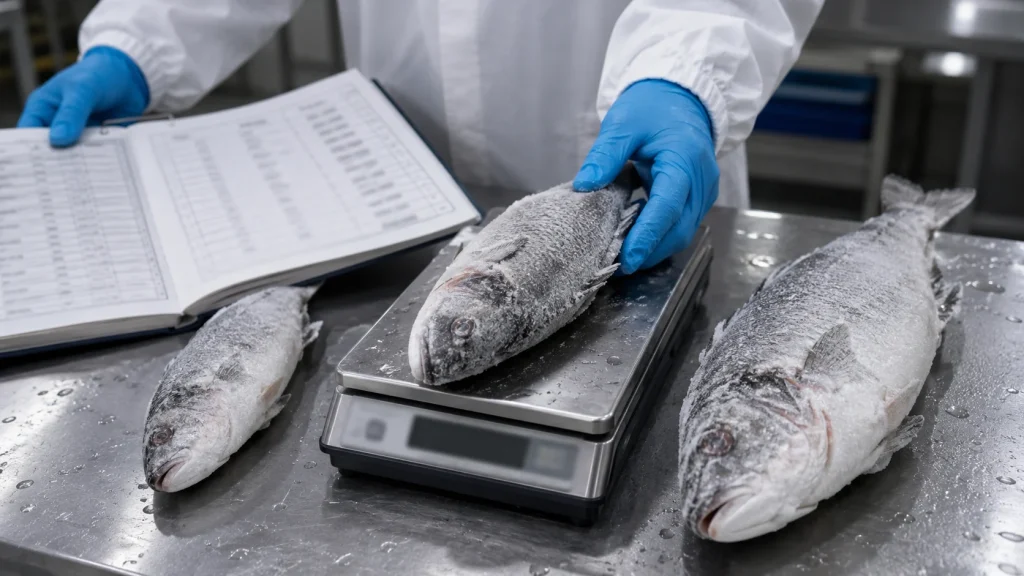
A frozen seafood catalog may list a product as “300-500 g,” “4/6 pcs/kg,” “6-8 oz,” or “3 lb up.” The numbers look simple, but they do not all describe size in the same way.
For a seafood buyer, misreading the notation can result in a product that is technically the right species but the wrong size for the intended portion, processing yield, menu, retail pack, or customer specification. This becomes even more important when comparing quotations from different suppliers, since two catalogs may use different grading systems for similar products.
There is no single universal size code for every frozen fish product. Depending on the species, processing form, supplier, and target market, size may be expressed as individual weight, count per kilogram, count per pound, length, or another agreed specification.
The safest approach is to read the size together with the unit, product form, and grading basis.
What does a fish size grade actually tell you?
A fish size grade usually groups products into commercially useful size ranges rather than describing one exact weight.
For example, a frozen fish listed as 300-500 g generally falls within a category where the relevant individual fish or processed unit weighs between 300 and 500 grams. Another product may instead be described as 4/6 pcs/kg, meaning approximately four to six pieces make up one kilogram.
FAO guidance on commercial fish grading shows that grading practices can vary by species and market. Fish may be classified by individual weight, the number of fish per unit of weight, or other commercial criteria. Market grades do not necessarily follow a single international grading system.
Before interpreting a size grade, look for three pieces of information:
- the product form, such as whole round, gutted, fillet, steak, portion, or butterfly cut;
- the numbers used for the size range or count;
- the measurement unit, such as g, kg, lb, oz, pcs/kg, or pcs/lb.
Without all three, a size description can easily be misunderstood.
Common fish size grade formats
Frozen seafood catalogs commonly use several grading formats. Different systems may even appear within the same catalog because different products are traded using different conventions.
| Catalog notation | Typical meaning | What to check |
|---|---|---|
| 300-500 g | Each relevant fish or piece falls within a weight range | Whether the weight applies to whole fish or processed product |
| 1-2 lb | Individual product weight in pounds | Product form and grading basis |
| 6-8 oz | Individual fillet, steak, or portion weight | Whether the weight applies per piece |
| 4/6 pcs/kg | Approximately 4-6 pieces make up 1 kg | Count basis and acceptable tolerance |
| 3 lb up | Individual product is in an open-ended grade starting around 3 lb | Exact meaning of “up” in the supplier specification |
| U/5 | Usually an “under” count category in count-based grading | Unit and supplier definition must be confirmed |
Intan Seafood’s 2026 catalog shows how these systems can coexist. Some fillets are offered in ounce ranges such as 6-8 oz, 8-10 oz, 10-12 oz, and 12-14 oz. Whole cleaned products may instead use pound ranges such as 0.5-1 lb, 1-2 lb, and 2-3 lb, while some butterfly-cut products are specified in gram ranges such as 100-200 g, 200-300 g, and 300-500 g.
None of these systems is inherently better than another. The important point is that the size notation must be read together with the seafood presentation. A 500 g whole fish, a 500 g fillet, and a 500 g processed portion are not equivalent products.
How to read weight-based grades
Weight-based grading is usually the easiest format to interpret.
If a catalog lists:
300-500 g/pc
the intended meaning is normally that each relevant piece falls within the 300 to 500 gram size category.
Similarly:
1-2 lb/pc
indicates an individual size range measured in pounds.
This format is common for both whole and processed fish, although the exact grading basis can vary. One supplier may grade a gutted fish by its delivered weight, while another specification may refer to the original whole-fish weight before processing.
That distinction matters when comparing suppliers.
For example, Nireus states that some of its processed whole-fish grades are based on the whole or round fish equivalent, while its fillets use separate fillet-weight ranges. A buyer who compares only the printed numbers could assume two products are equivalent even though the grading bases differ.
When buying headed, gutted, trimmed, filleted, or otherwise processed seafood, confirm whether the listed size refers to:
- the actual frozen product being delivered;
- the product before processing;
- or a whole-fish equivalent used for grading.
How to read count-per-kilogram grades
Count-based grading works differently from weight-per-piece grading.
Consider:
4/6 pcs/kg
This means approximately four to six pieces make up one kilogram.
Because the total weight is fixed at one kilogram, the relationship between the count and the size of each fish is reversed. Fewer pieces per kilogram generally means larger individual pieces.
For example, if one kilogram contained four equally sized fish, each would average about 250 g. If it contained six equally sized fish, each would average about 167 g.
Those calculations can help you understand the approximate scale of the grade, but they should not be treated as guaranteed individual weights. A count grade describes how many pieces make up a specified total weight. It does not necessarily establish a strict weight range for every fish.
Commercial frozen mackerel listings, for example, may use grades such as:
4/6 pcs/kg6/8 pcs/kg8/10 pcs/kg10/12 pcs/kg
In this sequence, 4/6 represents the larger fish category, while 10/12 represents the smaller one.
This is one of the easiest grading systems to misread if you assume that a higher number means a larger fish.
Why “4/6” and “4-6 oz” are not the same thing
The unit can be more important than the numbers themselves.
4/6 pcs/kg
is a count-based grade.
4-6 oz
is normally a weight-per-piece range when used for a fillet, steak, or portion.
Both contain the numbers four and six, but they describe completely different specifications.
The same caution applies to abbreviations such as “UP,” “+,” and “U/.”
A grade such as 500 g up or 3 lb up generally indicates an open-ended size category beginning at the stated weight.
“U/” is commonly used in count-based seafood grading to mean “under” a stated count. For example, U-10 shrimp is defined in U.S. government procurement guidance as ten or fewer shrimp per pound.
Some finfish suppliers also use similar U/ notation, but buyers should not assume the unit or exact interpretation is identical across every catalog. If a fish is listed as U/5, confirm whether the supplier means fewer than five pieces per kilogram, another count basis, or a supplier-specific category.
Size grade is not the same as quality grade
The word “grade” can also cause confusion because size grade and quality grade describe different things.
A size grade describes measurements such as individual weight or count.
A quality grade evaluates product quality against a defined standard.
NOAA seafood grading standards, for example, use quality classifications such as U.S. Grade A, B, and C based on specified product characteristics and defects. Size can then be specified separately.
A U.S. Marine Corps procurement specification issued in December 2025 provides a practical example: raw cod fillets may be required to meet U.S. Grade A quality while also meeting a separate 4-6 oz portion-size specification.
In a specification such as “Grade A, 4-6 oz,” the two parts serve different purposes. “Grade A” refers to the applicable quality requirement, while “4-6 oz” refers to the size of each portion.
Supplier-defined terms such as A, AA, A1, or A2 should likewise not be assumed to have a universal meaning unless the supplier provides the corresponding specification.
Does the size include ice glaze?
Frozen seafood is often protected with a layer of ice glaze, which introduces another weight-related question.
Codex standards for quick-frozen fish fillets state that the declared net contents of glazed products exclude the glaze. Codex analytical procedures for determining net product weight also describe removing the glaze before weighing the product itself.
That does not mean every commercial size grade in every supplier catalog is automatically based on deglazed weight.
Size grade and declared net weight are related but separate specifications. A catalog entry such as “300-500 g” may still require confirmation of how the supplier determines that grade.
For glazed products, buyers should distinguish between:
- the size category of the individual fish or portion;
- gross frozen weight;
- net product weight;
- and glaze percentage or glaze treatment.
This distinction matters when comparing quotations. Two products with the same nominal size range and price per carton may not represent the same amount of actual seafood if their packing or glaze specifications differ.
A size range does not always tell you the tolerance
Suppose a purchase specification says:
4-6 oz fillet
Does every fillet have to weigh between four and six ounces? That depends on the specification.
Some procurement standards set strict limits. The December 2025 U.S. Marine Corps buyer’s guide, for example, specifies certain 4-6 oz cod portions with no additional weight tolerance.
Other commercial agreements may allow a limited percentage of pieces outside the nominal range or use a sampling procedure to determine whether a production lot complies.
NOAA seafood inspection procedures treat net weight, count-based size designation, portion-control weight, weight range, and quality as separate inspection attributes. Sampling may then be used to evaluate compliance across a lot.
A commercial catalog usually does not provide this level of detail. For regular B2B orders, especially when retail, foodservice, or private-label specifications require consistent portions, a buyer may need to confirm:
- acceptable undersize and oversize tolerance;
- whether the range applies to every piece or to sampled pieces;
- how the supplier checks the size;
- and how lot acceptance is determined.
This can be particularly relevant when portion consistency affects packaging, menu costing, or customer specifications.
How to compare size grades from two seafood suppliers
Comparing only the price and printed size range can create a false comparison.
Imagine two quotations:
Supplier A: Snapper fillet, 6-8 oz, IQF
Supplier B: Snapper fillet, 170-230 g, IQF
At first glance, the products appear similar. The ranges may also be broadly comparable after unit conversion.
That still does not establish that the products have the same commercial specification.
A proper comparison should also confirm the species, cut, trim, grading basis, glaze, net weight, packing format, and tolerance. Even the term “fillet” may require further clarification if the products differ in skin condition, bone removal, trimming, or portioning.
A more reliable comparison therefore considers the complete product specification rather than treating size as an isolated field.
For buyers working with frozen seafood suppliers such as Intan Seafood, asking only “Do you have 300-500 g?” may leave too much room for interpretation.
A clearer request would confirm what product form the 300-500 g range applies to, how that size is measured, what glaze and packing specifications apply, and what size tolerance is acceptable. This gives the supplier enough information to quote and prepare the product against the intended market requirement.
A practical way to read any frozen fish catalog entry
When you encounter an unfamiliar size code, start by identifying the species and product form. A whole fish and a fillet from the same species will normally use different commercial specifications.
Next, check whether the size is expressed as weight per piece or count per unit of weight. Units such as g, kg, lb, oz, pcs/kg, or pcs/lb usually reveal the basic grading method.
Then determine what the grading weight refers to. For processed products, confirm whether it is the delivered weight or a whole-fish equivalent.
For glazed products, check whether glazing affects the weight comparison. Net seafood weight and the physical frozen weight of a glazed product are not necessarily the same.
Finally, confirm tolerances when consistency matters. A catalog range is a starting point for the specification, but it may not be the complete acceptance standard for a commercial shipment.
Reading size grades accurately makes quotations easier to compare
Fish size grades are useful shorthand, but only when the notation is read in context.
A range such as 300-500 g normally describes individual weight. A grade such as 4/6 pcs/kg describes count per kilogram, where fewer pieces generally mean larger fish. An ounce range may refer to a fillet or portion, while “up” can indicate an open-ended size grade.
These codes should always be read together with the product form, grading basis, glaze and net-weight specification, and any agreed size tolerance.
For importers, distributors, retailers, foodservice buyers, and other seafood businesses, confirming those details before issuing a purchase order makes it easier to compare suppliers accurately and receive frozen seafood that matches the intended application.
References
- FAO Fisheries Technical Guidance on Grading and Commercial Fish Sizes
- Intan Seafood 2026 Product Catalog
- Intan Seafood Grouper Fillet Product Information
- Codex Standard for Quick-Frozen Fish Fillets
- NOAA United States Standards for Grades of Fishery Products
- U.S. Marine Corps Subsistence Buyer’s Guide, December 2025
- Nireus Product Size and Processing Specifications