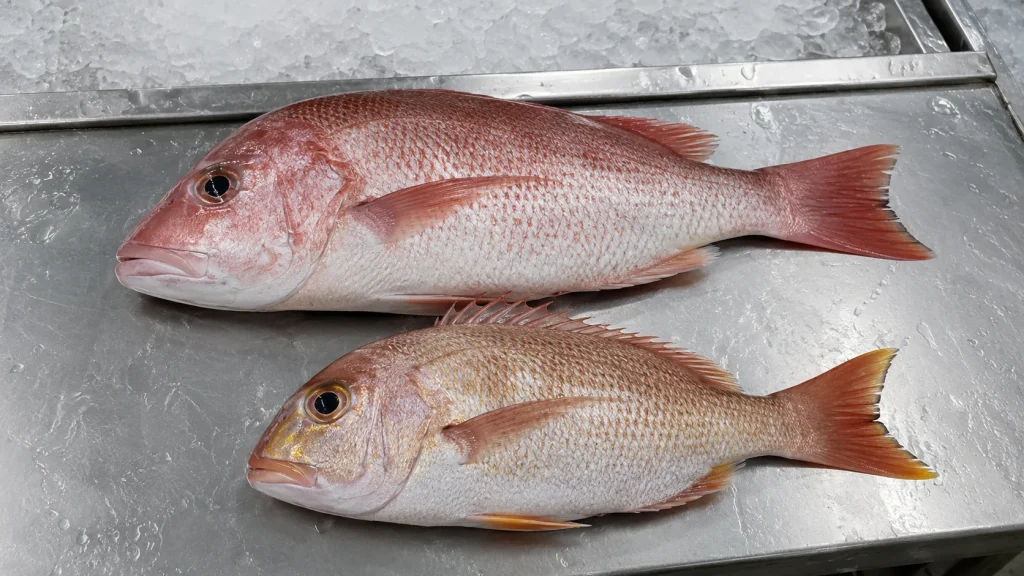
Pinjalo snapper and red snapper can look similar at a seafood counter, but they are not necessarily the same fish. Pinjalo snapper usually refers to Pinjalo pinjalo, a member of the snapper family Lutjanidae found in the Indo-West Pacific. “Red snapper,” however, is less straightforward because its meaning can depend on the species, market, and country where the fish is sold.
For seafood buyers, importers, distributors, and foodservice businesses, this is more than a naming detail. A product broadly sold as red snapper in one market may need a different commercial name in another, and reddish color alone is not enough to confirm the species.
What is Pinjalo snapper?
Pinjalo snapper generally refers to Pinjalo pinjalo, a tropical marine fish in the family Lutjanidae, which also contains many other fishes commonly known as snappers.
However, Pinjalo does not belong to the genus Lutjanus. It belongs to a separate genus, Pinjalo. FishBase recognizes two species in this genus: Pinjalo pinjalo and Pinjalo lewisi. The latter is commonly known as red pinjalo or slender pinjalo.
This distinction matters because seafood names can become confusing when terms such as “snapper,” “red snapper,” and “red pinjalo” overlap in commercial use.
Pinjalo pinjalo occurs across the Indo-West Pacific. It is mainly associated with reefs and rocky-bottom habitats and has been reported at depths of roughly 15 to 100 meters. FishBase gives a common length of around 30 cm, although the species can grow considerably larger.
Its natural range makes Pinjalo especially relevant to seafood sourcing in Southeast Asia, including Indonesia.
Is Pinjalo the same as red snapper?
Not in the taxonomic sense.
Pinjalo pinjalo is a distinct species, while fish sold or described as red snapper may belong to different species depending on the market and how the name is being used.
In the United States, the distinction is relatively strict. The U.S. Food and Drug Administration identifies Lutjanus campechanus as the species that may use “Red Snapper” as an acceptable market name. The FDA lists Pinjalo pinjalo under the market name “Snapper,” but not “Red Snapper.”
For a U.S. buyer asking specifically for Red Snapper, the name refers to Lutjanus campechanus, not Pinjalo.
The situation is less straightforward in parts of Southeast Asia. Indonesian fisheries terminology has historically used kakap merah, or red snapper, for a broader commercial group that can include several members of the Lutjanidae family.
A fisheries study from South Sulawesi, for example, recorded Pinjalo pinjalo alongside several Lutjanus species in catches categorized as red snapper. The species listed included Lutjanus malabaricus, L. hyselopterus, L. sebae, L. vitta, and P. pinjalo.
The safest interpretation is therefore that Pinjalo is not biologically the same species as Red Snapper, although it may be included within a broader red snapper commercial category in some regional seafood markets.
Pinjalo snapper vs. red snapper
The exact comparison depends on what “red snapper” means in the relevant market.
For a clear species-level comparison, Lutjanus campechanus, the species officially recognized as Red Snapper in the U.S. market, provides a useful reference.
| Feature | Pinjalo snapper (Pinjalo pinjalo) | Red Snapper (Lutjanus campechanus) |
|---|---|---|
| Family | Lutjanidae | Lutjanidae |
| Genus | Pinjalo | Lutjanus |
| General distribution | Indo-West Pacific | Western Atlantic |
| Head profile | High and strongly convex | Longer, more triangular face |
| Mouth | Relatively small | Larger snapper-like mouth with canine teeth |
| Eye | Relatively large | Less dominant in the head profile |
| Dorsal spines | 11 | 10 |
| Typical coloration | Pinkish, reddish, greenish-grey, or pinkish-grey | Generally pink to red |
| Fins | Pelvic and anal fins can appear yellowish | Generally reddish |
| U.S. FDA market name | Snapper | Snapper / Red Snapper |
These characteristics can help when examining whole fish, but identification should not be based on color alone.
How can you identify Pinjalo snapper?
Whole Pinjalo have several characteristics that are more useful for identification than simply checking whether the fish looks red.
The body is relatively deep and compressed from side to side. The head has a high, strongly convex profile, while the snout is comparatively short. Pinjalo also tends to have a relatively large eye and a smaller mouth than many Lutjanus snappers.
The pectoral fins are long, and the tail has a noticeably concave or forked profile. The pelvic and anal fins can also show yellowish coloration.
Color itself is variable. Adults can appear greenish-grey, pinkish-grey, pink, or reddish. Lighting, freshness, handling, freezing, and the condition of the fish can also affect how those colors appear.
For that reason, identifying Pinjalo simply as “the red fish with yellow fins” is unreliable.
Fin-ray and spine counts provide stronger taxonomic clues. FishBase records 11 dorsal spines and approximately 13 to 15 dorsal soft rays for P. pinjalo. By comparison, Lutjanus campechanus has 10 dorsal spines and 14 soft rays.
These details can be useful for trained inspectors or whole-fish verification, but they become much less practical once the fish has been processed.
Why Pinjalo can be confused with other red snappers
Pinjalo is not the only reddish lutjanid found in Indo-Pacific seafood trade.
A particularly relevant comparison for Indonesian and regional buyers is Malabar blood snapper, Lutjanus malabaricus. FAO describes this species as a deep-bodied, crimson-red snapper with a convex head.
At a quick glance, a reddish L. malabaricus and a reddish Pinjalo can therefore look similar.
There are useful physical differences. L. malabaricus has stronger jaw teeth and several moderate anterior canine teeth, while Pinjalo has a comparatively smaller mouth. Malabar blood snapper also has a truncate or only slightly indented tail, whereas Pinjalo has a more strongly concave tail profile.
This is one reason detailed purchasing specifications should use scientific names rather than relying only on trade names.
There is also evidence that this type of confusion has occurred in commerce. A peer-reviewed DNA barcoding study of Indonesian commercial fish sampled from retail markets, fishing ports, and processing facilities found specimens sold under red snapper identities that were genetically identified as Pinjalo lewisi and Pinjalo pinjalo.
The specimens were collected in 2012 and the research was published in 2016, so the study should not be interpreted as evidence of a present-day mislabeling rate. It does show, however, that similar appearance and overlapping market names have caused real identification problems in the seafood supply chain.
Geographic origin is another useful clue
The origin of the fish can help rule out some possible species.
Pinjalo pinjalo is an Indo-West Pacific species. Its range includes waters across the Indian Ocean and Southeast Asia toward areas such as Papua New Guinea and Taiwan.
By contrast, Lutjanus campechanus, the Red Snapper recognized by the FDA, is a western Atlantic species associated particularly with waters around the Gulf of Mexico and the Atlantic coast of the Americas.
A wild fish harvested in Indonesian waters can therefore naturally be Pinjalo pinjalo, but it cannot be wild-caught Lutjanus campechanus from those same waters.
For international seafood purchasing, this is a useful reminder that the common name on a quotation or carton should be consistent with the declared scientific name and origin.
Why scientific names matter when buying frozen snapper
Species identification becomes more difficult after processing.
A whole fish still provides clues such as head shape, teeth, fin structure, scale pattern, body proportions, and tail shape. Once the product has been headed, skinned, portioned, or filleted, many of those visible characteristics disappear.
This matters in frozen seafood procurement because “snapper” can refer to products from multiple species, while the permitted commercial name may also differ between destination markets.
For B2B purchasing, specifications should therefore go beyond a broad common name whenever species identity matters. Buyers can consider including:
- scientific species name;
- declared product or market name;
- country of origin;
- capture area where applicable;
- product form and cut;
- size or grading specification;
- packaging requirements;
- lot and traceability information.
This does not mean every order requires laboratory testing. The goal is to make the documentation precise enough that the supplier and buyer are referring to the same fish.
When visual identification is no longer possible, or when species authenticity needs to be confirmed, DNA barcoding can provide another level of verification. The FDA maintains reference COI barcode data for seafood species including Pinjalo pinjalo, showing how genetic identification can support seafood authentication.
Does Pinjalo taste different from red snapper?
Claims about taste and texture need more caution.
Commercial seafood descriptions often characterize Pinjalo as having pale flesh, a mild flavor, and a firm texture. These descriptions may help explain how the product is positioned in the market, but they do not establish that Pinjalo is consistently sweeter, milder, firmer, or better tasting than every fish sold as red snapper.
There is also no single sensory profile for “red snapper” when the term is used for different species in different markets.
Product condition matters as well. Freshness at freezing, handling, storage temperature, product form, fish size, thawing, and preparation can all affect eating quality.
For commercial buyers, species identity should therefore be considered separately from product quality. Two shipments of the same species can still perform differently if their handling, processing, freezing, glazing, packaging, or cold-chain conditions differ.
Can Pinjalo be sold as red snapper?
The answer depends on the destination market and its naming rules.
In some Indonesian fisheries and commercial contexts, red snapper has historically been used broadly enough to include several reddish Lutjanidae, including Pinjalo. This regional usage helps explain why exporters and buyers may encounter overlapping terminology.
The United States applies a narrower rule. The FDA Seafood List allows Lutjanus campechanus to use “Red Snapper” as a market name, whereas Pinjalo pinjalo is listed as “Snapper.”
Exporters should therefore not assume that a common trade name routinely used in one country will automatically be acceptable in another.
For international orders, the scientific species name provides a stable reference point. Labeling, product descriptions, cartons, and commercial documentation can then be prepared according to the requirements of the destination market.
What should seafood buyers check before choosing Pinjalo?
If you are evaluating Pinjalo for distribution, retail, foodservice, or further processing, the first question should not simply be whether it can replace red snapper. You first need to establish which species the comparison refers to.
If a customer specification requires Lutjanus campechanus, Pinjalo is a different species and should not be treated as the same product. If the buyer uses red snapper as a broader commercial category, the exact species should still be agreed on before production and shipment.
Product specifications should then cover practical requirements such as size, cut, freezing method, packaging, labeling, and destination-market requirements.
For an Indonesian seafood processor or exporter, this level of clarity is especially useful because locally available Indo-Pacific species may enter markets where familiar trade names are defined differently. Precise species identification can reduce misunderstandings between processors, importers, distributors, and their customers.
Pinjalo and red snapper are related, but the names are not interchangeable
Pinjalo snapper is a genuine member of the snapper family, but Pinjalo pinjalo is its own species and belongs to a different genus from many fishes commonly sold as red snapper. It should not automatically be treated as another name for Red Snapper.
Much of the confusion comes from commercial naming. In some Indo-Pacific markets, several reddish lutjanids may be grouped under a broad red snapper category. In markets such as the United States, “Red Snapper” has a much narrower species meaning.
For buyers sourcing frozen snapper internationally, the clearest way to avoid ambiguity is to confirm the scientific name first, then check the fish’s origin, product form, specifications, traceability, and the labeling requirements of the destination market.
References
- FishBase – Pinjalo pinjalo
- U.S. FDA Seafood List – Lutjanus campechanus
- Indonesian Ministry of Marine Affairs and Fisheries – Red Snapper Fishery Study
- International Journal of Food Science & Technology – DNA Barcoding of Commercial Fish in Indonesia
- NOAA Fisheries – Red Snapper
- FAO Species Identification Guide – Lutjanus malabaricus
- U.S. FDA – Pinjalo pinjalo Seafood Barcode Reference