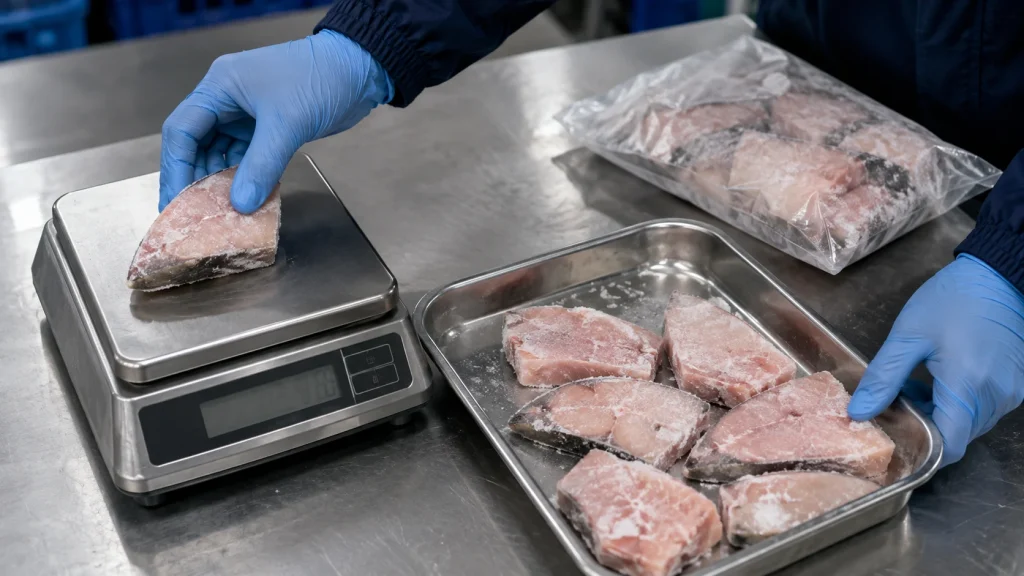
A frozen seafood sample can look excellent and still be a poor basis for a bulk purchasing decision. A carefully selected sample may have good color, clean trimming, and firm texture, while the commercial shipment later arrives with inconsistent sizes, excessive glaze, lower usable yield, cold-chain damage, or specifications that do not match the original quote.
For importers, distributors, retailers, foodservice businesses, and other B2B seafood buyers, sample evaluation should go beyond asking whether the fish “looks fresh.” The question is whether the sample matches the agreed specification, performs as expected after thawing and cooking, and gives you enough confidence to proceed to verification of the actual production lot.
Start with the product specification, not appearance
Before opening or thawing the sample, compare it with what the supplier actually offered.
The reference specification should identify the product clearly enough to leave little room for interpretation. Depending on the seafood, it may include:
- species and commercial name;
- product form and cut;
- raw or cooked status;
- wild-caught or farmed origin, where relevant;
- country of origin;
- skin-on or skinless specification;
- bone status and trimming requirements;
- size, count, or piece-weight range;
- IQF, block-frozen, or another freezing format;
- pack size and declared net weight;
- glazing;
- declared additives or moisture-retention treatments;
- packaging and private-label requirements.
This matters because visually similar frozen seafood can represent very different commercial products. A sample should be checked against measurable purchase requirements rather than a general impression of what “good quality” looks like.
Keep the approved specification together with the sample identification, production information, and date. If the supplier later produces the bulk order, both sides then have a clear reference instead of relying on memory or photographs.
Check the frozen condition before thawing
Some useful evidence disappears once seafood has thawed, so begin the inspection while the product is still frozen.
Codex guidance for quick-frozen foods uses -18°C or colder as an important temperature benchmark during frozen storage and distribution, subject to applicable tolerances and product requirements. Recording the sample’s temperature on arrival can therefore help document its condition.
One acceptable temperature reading, however, does not prove that the seafood remained continuously frozen before it reached you.
The condition of the frozen product can provide additional clues. Codex sensory guidance for seafood recommends checking for dehydration, discoloration, damaged wrapping or glaze, and signs consistent with thawing and refreezing. These can include distorted frozen blocks, frozen drip inside the packaging, or partial loss of glaze.
This is more reliable than using a simple rule such as “ice crystals mean the seafood was refrozen.” Ice can form for several reasons. A better assessment considers temperature records together with the packaging, product shape, glaze condition, and any other evidence of temperature abuse.
For a purchasing evaluation, document these observations before thawing or otherwise changing the condition of the sample.
Verify glaze and actual seafood weight
Glaze is not automatically a defect. A layer of ice can help protect frozen seafood from dehydration and freezer burn during storage.
The purchasing issue is whether the quantity of seafood matches the declared net weight.
For glazed seafood, weighing the package straight from the freezer can be misleading because some of that weight may be protective ice rather than seafood. Codex standards for products such as quick-frozen shrimp treat declared net contents as excluding glaze.
The difference can have a measurable commercial effect.
In a U.S. FDA surveillance assignment conducted during 2022 to 2024, 10 of 28 imported frozen seafood samples were found to be short weight, with shortages ranging from 2.3% to 9.9%. The FDA tested samples made up of multiple retail units from the same production lot using an established drained-weight procedure.
That finding should not be interpreted to mean that roughly one-third of all frozen seafood is underweight. The FDA noted that the assignment was small and included both targeted and surveillance samples, so it was not designed to estimate the prevalence of short-weight seafood across the wider market.
For buyers, the practical point is straightforward: if glaze affects the price you pay, check deglazed net weight using a consistent procedure instead of judging the package by gross frozen weight.
Measure size consistency instead of checking only the average
A sample can meet an average weight requirement while still containing pieces that vary too much for the intended application.
This is particularly relevant for restaurants, foodservice distributors, retail portion packs, and businesses that depend on predictable portion sizes and serving costs.
For individually portioned fish, examine several pieces and record characteristics such as weight, thickness, length where relevant, trim consistency, skin or bone remnants, and visible defects. A consistent range may be more useful commercially than a sample whose average falls within specification but contains unusually small and large pieces.
Count-based seafood requires similar care.
For quick-frozen shrimp, for example, Codex specifies that when count per unit weight is declared, the calculation is based on the number of shrimp and their actual deglazed weight. Simply counting frozen pieces in a glazed package therefore does not necessarily confirm the commercial size grade.
The exact grading system depends on the species and product format, but the same principle applies: measure the characteristic that the purchase specification actually promises.
Inspect the product frozen, thawed, and cooked
No single inspection stage reveals every quality issue.
A more useful evaluation checks the seafood in three states:
| Evaluation stage | What it can reveal |
|---|---|
| Frozen | Glaze condition, dehydration, packaging damage, discoloration, deformation, and possible cold-chain problems |
| Thawed | Drip loss, flesh condition, odor, texture, trimming defects, discoloration, and structural integrity |
| Cooked | Flavor, cooked odor, texture, mouthfeel, and suitability for the intended application |
Codex sensory guidance supports examining seafood in the relevant frozen, thawed, and cooked states.
The thawed stage matters because freezing changes some of the characteristics commonly used to judge fresh fish. Features such as the eyes, gills, skin, and appearance of blood may change during freezing and thawing, so standards used for freshly landed fish cannot simply be applied unchanged to previously frozen seafood.
For fillets and portions, buyers can instead look for abnormal odor, oxidation-related discoloration, excessive liquid release, flesh damage, and whether the product maintains the expected structure after thawing.
Cooking answers another question: does the seafood perform properly when prepared for its intended use?
A raw fillet may look acceptable but still produce undesirable texture, flavor, or moisture behavior once cooked.
Standardize the thawing and cooking test
Comparisons are only useful when samples are handled in the same way.
If two suppliers’ products are thawed under different conditions, weighed at different stages, or cooked with different methods, the test may reflect handling differences rather than actual product differences.
Use the same thawing method, similar portion sizes, comparable cooking conditions, and the same evaluation criteria whenever possible.
Record specific observations instead of descriptions such as “good texture” or “nice quality.” Note whether the flesh remains firm or becomes soft after thawing, whether portions break apart during handling, how much liquid is released, and whether the cooked texture suits the intended application.
For commercially significant evaluations, having more than one trained person assess sensory characteristics can also reduce the influence of individual preference.
Sensory testing has limits. Codex guidance states that sensory analysis alone should not be used to determine whether additives are present or whether permitted additives exceed an acceptable level.
A buyer should therefore avoid assuming that unusually firm, moist, or juicy seafood proves improper chemical treatment. If additive compliance matters, compare the declared treatment with the agreed specification and destination-market requirements, and use appropriate analytical testing when necessary.
Check laboratory evidence based on the actual product risk
Requesting a certificate of analysis can be useful, but receiving a document marked “passed” is not enough on its own.
The relevant hazards vary considerably between seafood products.
FDA seafood safety guidance, for example, identifies potential hazards that can include parasites, natural toxins, histamine or scombrotoxin formation, environmental contaminants, methylmercury, aquaculture drugs, pathogenic bacteria associated with time-temperature abuse, allergens, and physical hazards.
Not every hazard applies equally to every product.
A frozen tuna product, farmed whitefish fillet, squid product, and shrimp product may require different controls depending on the species, production method, processing, intended use, origin, and destination market.
When laboratory testing is relevant, check whether the report relates to the same product and production lot, what was tested, which method was used, and what acceptance limit was applied.
A generic certificate from another batch should not be treated as proof that the sample or future bulk shipment meets every applicable requirement.
Do not confuse sample approval with bulk-lot approval
This distinction is easy to miss in seafood procurement.
An excellent supplier sample shows that the supplier can produce an acceptable product. It does not prove that thousands of kilograms from the commercial production run will have the same size distribution, glaze level, trimming, sensory quality, net weight, or overall consistency.
Formal seafood standards show why representative lot sampling matters.
For quick-frozen shrimp, Codex uses defined lot-sampling procedures for assessing specified end-product requirements, including an AQL of 6.5 for certain defect evaluations. For IQF shrimp examination, the standard specifies a sample unit of at least 1 kg and also considers criteria such as declared count and average net weight.
That does not mean every buyer should automatically add “AQL 6.5” to a purchase contract. The appropriate inspection plan depends on the product, contractual requirements, buyer risk, shipment size, and destination-market requirements.
What matters is that bulk production receives its own verification.
A practical approval sequence is:
- Confirm that the supplier sample matches the agreed product specification.
- Keep the approved sample or documented measurements as the reference standard.
- Confirm packaging, documentation, and any required laboratory evidence.
- Inspect representative units from the actual production lot or arrange an appropriate pre-shipment inspection.
- Compare the commercial lot with the approved specification before final acceptance.
This helps prevent a hand-picked sample from being treated as representative of an entire shipment without further checks.
Keep regulatory approval separate from product quality
A sample can have good sensory quality and still fail to meet the requirements of its destination market.
Export eligibility may involve approved establishments, health certificates, traceability systems, food-safety controls, labeling rules, testing, or other requirements that cannot be confirmed simply by inspecting the seafood.
For example, the European Union applies specific conditions to imports of products of animal origin, including requirements related to eligible countries or regions, approved establishments where applicable, and official certification.
For Indonesian seafood processors and exporters, the Ministry of Marine Affairs and Fisheries describes Sertifikat Kelayakan Pengolahan (SKP) as part of the processing-compliance system based on GMP and SSOP and as a prerequisite within the HACCP certification process used to support export requirements.
These examples are not a universal checklist for every destination. Requirements vary by market.
For international buyers, product evaluation and regulatory verification should therefore be handled as separate but related checks. A successful sample tasting, HACCP documentation, or certificate of analysis does not by itself establish that every requirement for a particular destination has been met.
Decide whether to approve, conditionally approve, or reject
Sample evaluation does not always need to end with a simple yes or no.
Full approval may be appropriate when the measurable characteristics match the agreed specification and there are no unresolved issues affecting the purchase.
Conditional approval may make more sense when the sample itself is acceptable but final production-lot inspection, packaging confirmation, laboratory results, documentation, or destination-market requirements are still pending.
Rejection should be linked to specific deviations. Instead of saying that the seafood simply “doesn’t look good,” document what failed: piece weights outside the agreed range, unacceptable trimming, the wrong product form, a net-weight shortage, excessive defects, poor thawed condition, unacceptable cooked performance, or another measurable requirement.
This gives the supplier a clearer basis for corrective action and makes a resubmitted sample easier to assess consistently.
Common mistakes that make sample approval unreliable
Several shortcuts can make a sample test less reliable than it appears.
Judging only color, smell, and appearance ignores yield, glazing, sizing, thaw behavior, cooked performance, and specification compliance.
Weighing glazed seafood without deglazing can also give a misleading picture of the actual seafood quantity. Similarly, examining one unusually attractive fillet or portion says little about consistency across a commercial lot.
A single acceptable arrival temperature should not be treated as proof of the product’s entire cold-chain history. Likewise, ice crystals alone should not automatically be treated as proof of refreezing.
Another common weakness is accepting laboratory paperwork without checking whether it corresponds to the relevant product, lot, test method, and acceptance requirement.
Verbal sample approval also leaves too much room for disagreement later. The characteristics that matter to the buyer should be recorded in the written purchase specification so the commercial production lot can be checked against the same standard.
A sample should reduce uncertainty before you scale the order
Evaluating a frozen seafood sample is about more than deciding whether one piece of fish is acceptable. The purpose is to reduce uncertainty before committing to a much larger purchase.
That means checking product identity and specification, frozen condition, deglazed weight, size consistency, physical defects, thawing behavior, cooked performance, relevant documentation, and any product-specific safety requirements.
For buyers sourcing from processors and exporters such as Intan Seafood in Indonesia, the same principle applies whether the requirement involves demersal fish, pelagic fish, tuna, squid, portion-controlled products, private-label packaging, or another frozen seafood format. Define what the bulk product needs to deliver, evaluate the sample against those requirements, and verify that the actual production lot still meets them before final acceptance.
References
- Codex Standard for Quick Frozen Shrimps or Prawns
- Codex Recommended International Code of Practice for the Processing and Handling of Quick Frozen Foods
- Codex Guidelines for the Sensory Evaluation of Fish and Shellfish in Laboratories
- FDA Sample Collection and Analysis of Imported Frozen Seafood for Economically Motivated Adulteration
- FDA Fish and Fishery Products Hazards and Controls Guidance
- European Commission Requirements for Products of Animal Origin for Human Consumption
- KKP Indonesia: Integration of SKP and HACCP Services for Fisheries Exports