


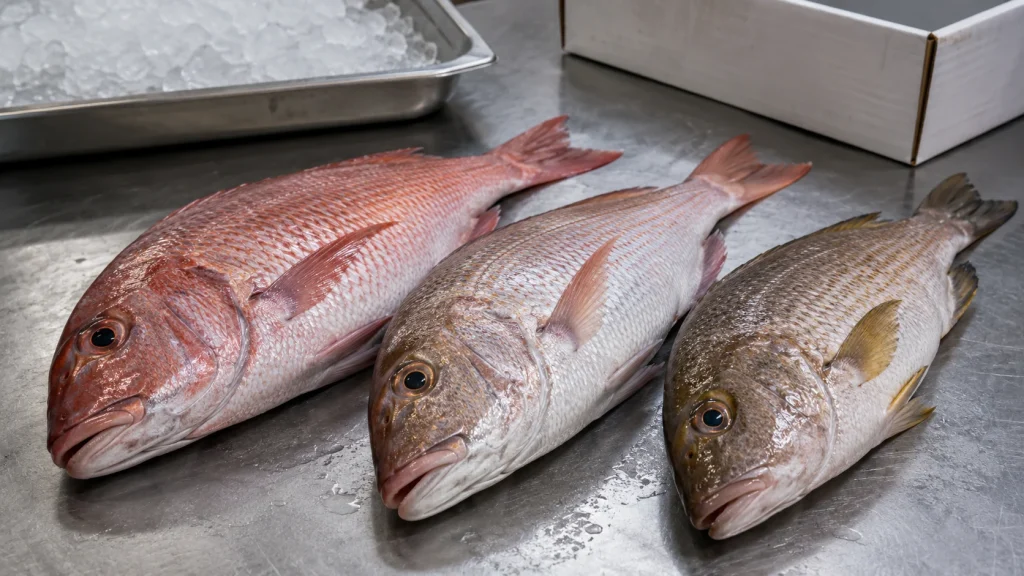
A seafood quotation that lists “snapper” may sound specific, but the name does not always identify a single fish species. Depending on the country, supplier, local fishing tradition, and commercial naming system, snapper can refer to several species and, in some cases, even fish outside the family usually considered the “true snappers.”
For seafood buyers, this is more than a naming detail. Two suppliers can both offer snapper while supplying biologically different fish. Those differences can affect available sizes, appearance, sourcing, product specifications, labeling requirements, and how the product is recognized in the destination market.
The safest way to know exactly what fish is being offered is not to rely on “snapper” alone. The scientific species name should be part of the product identification.
Snapper is a common name, not a single species
In biological classification, many fish commonly called snappers belong to the family Lutjanidae. Recent scientific literature recognizes approximately 113 species across 17 genera in this family, with the genus Lutjanus accounting for roughly 73 species.
That alone explains part of the confusion. “Snapper” can legitimately describe many different fish even when the discussion is limited to true snappers.
Examples include Crimson Snapper (Lutjanus erythropterus), Cubera Snapper (Lutjanus cyanopterus), Caribbean Red Snapper (Lutjanus purpureus), and Yellowtail Snapper (Ocyurus chrysurus). They are related, but they are not the same species.
It helps to separate three levels of identification:
| Type of name | Example | What it tells a buyer |
|---|---|---|
| Broad common or market name | Snapper | May cover several species |
| More specific common name | Crimson Snapper | Narrows the identity, but naming can still vary by market |
| Scientific name | Lutjanus erythropterus | Identifies a specific species |
The scientific name is especially useful in international trade because common names are not used consistently across countries.
The same market name can cover several species
The U.S. Food and Drug Administration’s Seafood List shows how broad the commercial term can be.
FDA currently accepts “Snapper” as a market name for several species, including Lutjanus erythropterus, Lutjanus cyanopterus, and Lutjanus purpureus. Yellowtail Snapper, Ocyurus chrysurus, belongs to another genus but is also part of the broader snapper terminology.
The Seafood List was updated again in August 2026, when species including Lutjanus russellii and Lutjanus vitta were added with “Snapper” as an acceptable market name.
So, seeing “snapper” on commercial documentation does not necessarily tell a buyer which species is being supplied.
It also means that two products sold under the same broad commercial name are not automatically interchangeable. If a buyer requires a particular species because of customer preference, processing yield, expected size range, appearance, or destination-market requirements, the broad name alone is not enough.
The meaning of snapper changes between markets
The naming issue becomes more complicated once seafood moves between countries.
Australia’s Fish Names Standard, for example, uses the standard name “Snapper” for Chrysophrys auratus, a fish in the family Sparidae rather than Lutjanidae. The same Australian system separately recognizes species such as Crimson Snapper (Lutjanus erythropterus), Saddletail Snapper (Lutjanus malabaricus), and Goldband Snapper (Pristipomoides multidens).
In an Australian context, the unmodified word “snapper” can therefore point to a different taxonomic group from the fish an importer elsewhere might expect when hearing the same term.
Regional fisheries terminology has developed around local species, fishing industries, and consumer familiarity. When seafood enters international trade, those different naming systems overlap.
A name that is normal and well understood in one market may be too broad, unfamiliar, or interpreted differently in another.
“Snapper” and “red snapper” are not always interchangeable
Another common source of confusion is the assumption that snapper and red snapper mean the same thing.
They do not necessarily.
In the United States, FDA permits Lutjanus campechanus to be marketed as either “Snapper” or “Red Snapper.” FDA policy specifically reserves the market identity “Red Snapper” for Lutjanus campechanus.
Another species may have the words “red snapper” in a common or regional name without being allowed to use exactly the same market designation.
For example, Lutjanus purpureus is known as Caribbean Red Snapper, but FDA lists its acceptable market name as “Snapper.” A name that sounds more specific is therefore not automatically the correct commercial label in every jurisdiction.
For exporters and importers, this means a familiar English common name should not be assumed to have the same accepted meaning in every destination market.
Some fish called snapper are not true snappers
Not every fish called snapper belongs to Lutjanidae.
Regional naming systems can apply the term to species outside that family because common names developed through local fishing and trading practices rather than through one global taxonomic system.
A current naming debate in the United States shows how commercial terminology can change. On March 31, 2026, FDA requested public input on whether 18 species of Sebastes, traditionally marketed as rockfish, should be allowed to use different market names after Congress directed the agency to consult the industry.
Some stakeholders proposed using “snapper.” FDA noted that its existing naming policy associates Sebastes with “rockfish” and Lutjanus with “snapper,” and raised concerns about how a name change could affect consumer understanding, product value, and seafood identification.
Based on the August 2026 Seafood List update covered in the research, this should still be treated as a naming issue under consideration rather than evidence that Sebastes species have broadly become “snapper.”
The case shows that seafood market names are shaped by more than taxonomy. Regulation, established trade practice, consumer understanding, and regional usage can all affect which names are accepted.
Indonesia also uses broad snapper terminology
The same naming issue appears in Indonesia, an important source market for tropical demersal fish.
An Indonesian fisheries study covering catches from the Arafura Sea documented a broad red-snapper grouping that included several Lutjanus species as well as fish from other related genera.
The recorded group included Lutjanus malabaricus, Lutjanus erythropterus, Lutjanus bohar, Lutjanus sebae, Lutjanus argentimaculatus, Lutjanus timorensis, Lutjanus monostigma, Pinjalo pinjalo, several Pristipomoides species, and Etelis carbunculus.
This matters to international buyers sourcing from Indonesia. Local commercial categories such as kakap or broader red-snapper groupings can be useful within the supply chain, but they should not replace species-level identification when a buyer requires a precise specification.
For an Indonesian processor or exporter serving several destination markets, the task is not simply to translate a local fish name into English. The supplier and buyer need to confirm which biological species the trade name refers to and whether the chosen commercial designation is appropriate for the destination market.
Why species identification matters to seafood buyers
Knowing the species helps avoid several purchasing problems.
Closely related snapper species can differ in natural size range, body shape, habitat, and fishery characteristics. A buyer purchasing whole fish, fillets, portions, or other frozen formats may therefore receive a product that does not match the expected dimensions or appearance if the specification uses only a broad common name.
Processing also removes many of the physical features used to distinguish one fish from another. Once a fish has been headed, filleted, skinned, portioned, frozen, or packed, visual identification becomes much more difficult.
Naming rules can also vary by destination. A supplier’s normal trade name at origin may not be the preferred or permitted market name where the product will ultimately be sold.
Clear species identification also improves traceability. When purchase orders, quality-control documents, packaging requirements, and supplier records all refer to the same scientific identity, there is less room for confusion between buyer and seller.
Broad names do not automatically mean mislabeling
The ambiguity around snapper does not mean every product using a broad name is mislabeled.
A generic name may be fully legitimate under the relevant market rules. The problem begins when the name implies a different species from the one actually supplied or when a specific protected commercial identity is used incorrectly.
DNA studies show why this distinction becomes especially important once seafood enters the supply chain.
A 2020 study in North Carolina analyzed 43 products sold as “red snapper” that could be successfully identified through DNA barcoding. About 90.7% were not Lutjanus campechanus. Frequently identified substitutes included vermilion snapper and tilapia.
That figure should not be treated as a global snapper mislabeling rate. The study was geographically limited and based on a small sample. It does, however, show how difficult it can be for consumers and commercial buyers to verify species from a market name alone.
For higher-risk or disputed cases, DNA identification is one available verification method. FDA’s seafood reference library uses a standardized region of the mitochondrial cytochrome c oxidase subunit I, or COI, gene and contains reference information for more than 1,040 seafood specimens.
Routine purchasing does not necessarily require laboratory testing. The availability of DNA testing simply reinforces the distinction between a common market name and a biological species identity.
What to confirm when buying snapper
For a B2B buyer, “snapper” should be the beginning of the product description rather than the entire specification.
Before confirming an order, the product specification should normally make clear:
- the scientific species name;
- the commercial or common name being used;
- the country or area of origin where relevant;
- the product form, such as whole round, gutted, fillet, loin, steak, or portion;
- the size or weight specification;
- packaging and labeling requirements; and
- any destination-market naming requirements that affect the product.
The scientific name is the most reliable reference because it remains specific even when local or commercial names vary.
This is particularly useful when an importer compares quotations from suppliers in different countries. Two offers labeled “snapper” may represent different species. Conversely, two suppliers using different common names may sometimes be referring to the same species.
A processor and exporter such as Intan Seafood can help clarify this by confirming the exact species, cut, size, packaging, and market specification required before production and shipment.
The name alone does not tell you which snapper you are buying
“Snapper” is a useful and familiar seafood category, but it is not a universal species name.
The term can describe numerous members of Lutjanidae, different genera within that family, and, in some regional naming systems, fish outside the true snapper family. Adding terms such as “red,” “crimson,” or another local descriptor can narrow the meaning, but those names still do not carry exactly the same commercial meaning in every country.
For seafood buyers, the practical approach is simple: use the common name for communication, but confirm the scientific name for identification. That makes supplier comparisons clearer and reduces uncertainty around product specifications, labeling, and international trade.
References
- A chromosome-level genome assembly of the snapper Lutjanus erythropterus – Scientific Data
- FDA Seafood List – Lutjanus erythropterus
- FDA Seafood List – Lutjanus campechanus
- Australian Fish Names Standard – Fisheries Research and Development Corporation
- FDA Seeks Public Input on Potential Market Name Change for Certain Rockfish Species
- Indonesian fisheries study of red snapper resources in the Arafura Sea
- DNA barcoding study of products sold as red snapper – PeerJ
- FDA Reference Standard Sequence Library for Seafood Identification


